













































This report was originally published by The 19th and is republished here. Reporting by Kate Sosin.
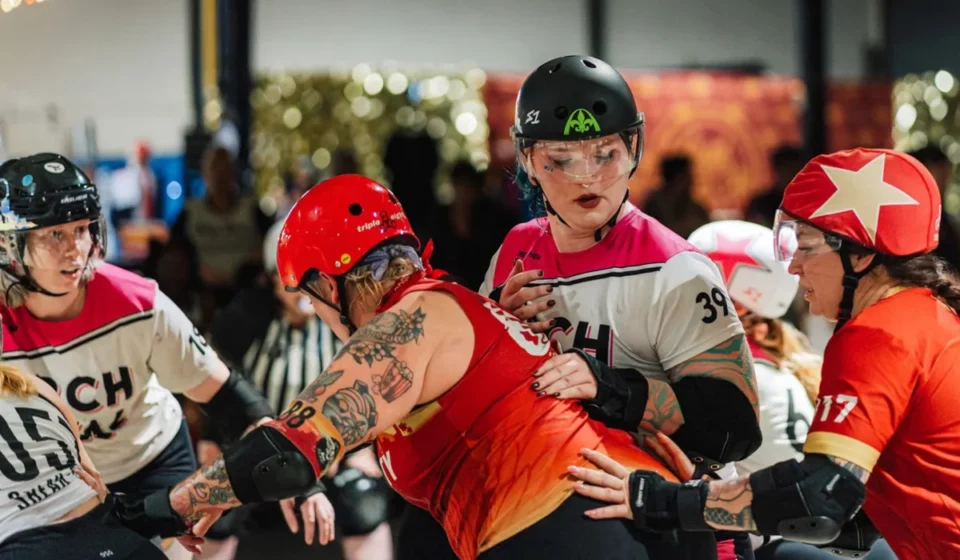
In the landscape of modern athletics, where the participation of transgender athletes has become a flashpoint for intense political and legislative debate, one high-contact, punk-rock-inspired sport has quietly been building a different path. Roller derby, a sport defined by its visceral physicality and "do-it-yourself" ethos, has spent the better part of two decades navigating the complexities of gender identity, creating a model of inclusion that challenges the traditional, exclusionary binary often found in elite sports.
For Juniper Simonis, the memory of 2012 remains as vivid as a favorite film. It was a humid summer evening in Ithaca, New York. As she sped through the city streets on her bicycle, the music of American folk singer Mariee Siou pulsing through her headphones, she carried a digital message that would change her life: The Ithaca League of Women Rollers had voted to allow her to join their ranks.
"As somebody who played sports and was queer, but those were two very separate parts of my life, the promise and the opportunity to integrate those was very hopeful for me," Simonis reflects. As a transgender woman, being welcomed into an all-women’s athletic collective was a moment of profound validation. "Getting a message that was like, ‘You are welcome,’ was very, obviously, very uplifting."
Yet, that sense of belonging exists alongside a reality of ongoing struggle. Despite the sport’s progressive strides, trans athletes in roller derby continue to navigate a landscape of imperfect policies, microaggressions, and, in some cases, physical safety concerns.
A Chronology of a Counter-Culture Sport
To understand how roller derby arrived at its current stance on gender, one must look at its evolution from a 1930s endurance gimmick to a grassroots movement. The sport was born from the mind of promoter Leo Seltzer, who envisioned a marathon-style endurance race on a banked track. Interestingly, the earliest iterations of the sport were co-ed, though the gendered pay gap of the era ensured men earned significantly more than their female counterparts.
As the sport transitioned into the mid-20th century, it took on the form of a high-octane, televised spectacle. However, its modern identity was forged in 2001 in Austin, Texas. A group of women sought to formalize the sport, creating a structure that balanced athletic competition with a distinct, rebellious aesthetic.
"There was definitely something really cool about a tough punk rock chick of that era," explains Rachel "Rotten" Johnston, a derby veteran and Director of the Angel City League. "It was like, I get to wear this badass outfit that’s also kind of sexy… It was post-riot grrrl coming into the 2000s, a direct rebuttal of the pop culture that was happening."
The movement replaced the mainstream pop culture icons of the early aughts—Britney Spears and Paris Hilton—with figures like "Beyonslay" and "Iron Maven." It was a space designed by women, for women, operating outside the constraints of traditional sports.
The Shift Toward Radical Inclusion
As the sport exploded in popularity, with the Women’s Flat Track Derby Association (WFTDA) eventually representing over 400 leagues across six continents, the question of gender became central to its identity.
In the early 2000s, the sport’s primary focus was carving out a space for women away from cisgender men. As Nicole Williams—a legendary skater known as "Bonnie Thunders" and often cited as the "LeBron James" of the sport—recalls, the term "cisgender" wasn’t even part of the common lexicon. "It was cis men that we didn’t want," she says.
Early policies mirrored those of the International Olympic Committee, requiring trans women to undergo hormone replacement therapy (HRT) for a minimum of two years to compete. However, this policy was inconsistently applied. Many local leagues, driven by the sport’s queer-friendly ethos, welcomed trans skaters long before formal policies were codified.
Penelope "Fifi Nomenon" Nederlander’s experience in 2010 serves as a case study in this informal transition. When she tried out for the LA Derby Dolls, she was terrified of the disclosure process. When she eventually told a mentor that she was trans, the mentor’s response was a simple, "Oh, I had no idea." Upon learning that Nederlander’s government identification listed her as female, the league simply welcomed her. "It was the first group of friends who I met who only knew me as Penny, and that was huge," she notes.

Formalizing the Future: The 2015 Policy Shift
The turning point for the sport came in 2015. After years of operating on a case-by-case basis, the WFTDA officially updated its policy to welcome anyone of a "marginalized gender," regardless of their transition status or appearance.
This policy change did more than just allow trans women to compete; it created a safe harbor for nonbinary athletes and those assigned female at birth who were beginning their own medical transitions. Drew "OMG WTF" Flowers, a nonbinary skater who has been involved in the sport since 2008, admits that the decision to transition while in the sport was terrifying. "I identified so hard with this being a female sport, a woman’s only sport," Flowers says. "I really kind of didn’t give the benefit of the doubt to my teammates, to my community, that they were going to be supportive of me."
Ultimately, the community did not just support them—they embraced them. Today, Flowers and their partner, Nicole Williams, continue to skate at the highest levels, their presence a testament to the sport’s commitment to evolving with its athletes.
Supporting Data and The Reality of Marginalization
While the policies have progressed, the lived experience of athletes suggests that institutional rules are only one part of the equation. Donita "Blaxyl Rose" Green, who skates for Angel City Derby, emphasizes that the intersection of race and gender identity creates unique challenges.
"I’ve seen firsthand how much worse some of these microaggressions and problems happen when you are a dark-skinned Black skater," Green explains. "You add knowledge of trans identity, and it tends to be even worse."
Furthermore, the physical nature of the sport does not exempt it from prejudice. Juniper Simonis reports having been assaulted by other players specifically due to her status as a transgender woman. These incidents highlight that despite a supportive policy framework, the culture of a sport is still susceptible to the broader societal transphobia that exists outside the track.
Implications for the World of Sports
Roller derby’s refusal to sacrifice inclusion for "perceived legitimacy" stands in stark contrast to the trajectory of many other sports. The sport was once considered for the Olympics, but the community ultimately walked away from that prospect. The reason? The requirement to comply with the rigid, exclusionary gender policies often demanded by international governing bodies.
The derby community concluded that the price of Olympic recognition—the potential alienation of their own athletes—was not worth paying.
As the national debate over gender in sports continues, some within the community advocate for more transparent conversations. Penelope Nederlander suggests that acknowledging biological differences between cisgender athletes does not have to result in the exclusion of trans women.
"I want to arrive at the same conclusion, but with honesty about it," Nederlander says. "In roller derby, there doesn’t seem to be an important difference. We really don’t have any complaints about trans skaters. So that’s awesome."
Ultimately, the lesson of roller derby may be that fairness in sports is a fluid concept, often weaponized to exclude rather than protect. As Rachel Johnston notes, the argument that trans inclusion poses a threat to safety ignores the very nature of the sport. "I think that people who are concerned about people getting hurt are missing the fact that we’re playing a full contact sport," she says. "You’re going to get hurt no matter what. You know, life isn’t fair, and sports most certainly are not fair."
For a sport built on the foundation of punk-rock defiance, the track remains a space where the rules are written by those who skate on it—and for now, those rules are inclusive.