

















































The Great Return: Target Mandate and the Revitalization of Downtown Minneapolis

MINNEAPOLIS — On a recent Monday morning, the rhythmic hiss of the espresso machine at Corner Coffee served as a percussion to a scene downtown Minneapolis hasn’t witnessed with such intensity in years. For Mia Pariseau, the store’s manager, the typical early-week lull has been replaced by a sustained rush. For over an hour, a queue of at least five customers deep snaked through the shop—a microcosm of a much larger shift occurring in the city’s concrete heart.
“We got just slammed,” Pariseau remarked, noting that she and a single colleague struggled to keep pace with the sudden influx of caffeine-seeking professionals.
The catalyst for this surge is not a one-off event or a seasonal festival. Rather, it is the result of a significant policy shift at Target Corporation, the city’s second-largest employer. As of September 2, 2024, Target’s commercial unit was ordered back to the office for a minimum of three days a week. Given that Corner Coffee sits just a stone’s throw from Target’s sprawling headquarters, the shop has become a front-line observer of the city’s post-pandemic evolution.
As Minneapolis navigates the complexities of a "new normal," the return of thousands of corporate employees is doing more than just boosting latte sales; it is fundamentally altering the energy, economy, and future trajectory of the Upper Midwest’s largest business district.
I. Main Facts: The September Surge
The resurgence of downtown Minneapolis is currently anchored by the "September Surge," a term local business owners are using to describe the impact of Target’s latest return-to-office (RTO) mandate. While many companies have experimented with hybrid models over the last two years, Target’s decision to formalize a three-day in-person requirement for its commercial unit represents a tipping point for the central business district.
The Scale of the Return
Target Corporation remains a titan of the downtown landscape, trailing only Hennepin Healthcare in total employee count within the city core. When a major player of this magnitude shifts its policy, the ripple effects are felt across the entire ecosystem—from the skyway vendors to the transit systems.
According to Kittie Fahey, the senior director of advancement for the Minneapolis Downtown Council, in-person work has climbed to nearly 75% of pre-pandemic levels. This figure is expected to rise further as the data from Target’s September mandate is fully processed and as other major employers, such as Wells Fargo and Ameriprise Financial, continue to enforce their own in-office requirements.
A New Energy
For employees like Madelyn Dunn-Lammert, an associate designer for Target, the shift marks a transition from the isolation of the home office to the collaborative environment of the IDS Center and surrounding hubs. Dunn-Lammert, who began her career three years ago largely in a remote capacity, noted that the change is palpable.
“It’s more vibrant and exciting during the day,” she said. Beyond the aesthetics of a busy street, she emphasized the functional benefits of proximity. In creative fields, the ability to grab a quick lunch with a colleague or pivot a project through an impromptu in-person brainstorming session is seen as a vital component of professional growth and team cohesion.
II. Chronology: From "Ghost Town" to Growing Pains
The journey to 75% occupancy has been a long and often fraught one. To understand the significance of the current moment, one must look at the timeline of the city’s decline and its subsequent, staggered recovery.
2020–2021: The Great Vacancy
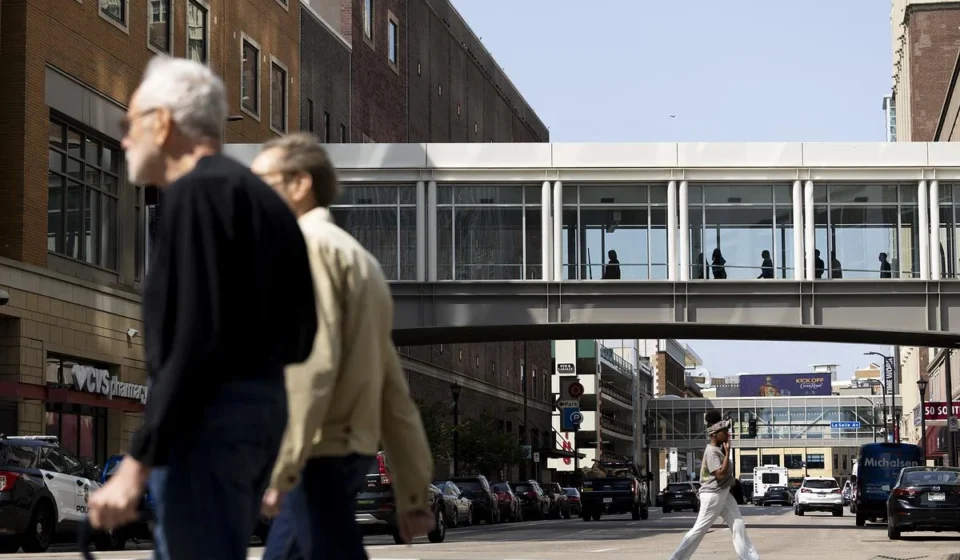
Following the onset of the COVID-19 pandemic in March 2020, Minneapolis, like many major metropolitan areas, saw its downtown core empty almost overnight. The city’s famous skyway system—a 9.5-mile network of enclosed pedestrian footbridges—became a series of silent glass tunnels. Jenny Lissarrague, an attorney who has worked downtown since 2012, recalls this period with a sense of unease.

“I came down here during some of those high pandemic years, and it was a ghost town,” Lissarrague said. “It was just nobody.” During this era, Minnesota’s share of remote workers peaked at 21% in 2021, significantly higher than the national average of 17.9%.
2022–2023: The Hybrid Experiment
As vaccines became widely available, a slow trickle of workers returned. However, Minnesota remained somewhat of an outlier in its retention of remote work. By 2022, the state’s share of remote workers had dropped to 16.9%, but the "vibrancy" of the city remained muted. Many offices operated on "zombie schedules," where buildings were technically open but desks remained empty.
June 2024: The Public Sector Lead
A major precursor to the current Target mandate occurred in early summer 2024. Starting June 1, Minnesota state government employees were required to spend at least 50% of their workdays in the office. This move was met with significant resistance from labor unions and state workers, some of whom threatened strikes or sought alternative employment. Despite the friction, the policy injected a consistent baseline of foot traffic into the city’s government district.
September 2024: The Corporate Catalyst
The Labor Day milestone became the "back-to-school" moment for the private sector. Target’s commercial unit joined the ranks of the 12 out of 15 top downtown employers who now have formal back-to-office policies. This move has transitioned the city from a state of "optional attendance" to "structured presence."
III. Supporting Data: The Economics of Presence
The revitalization of a downtown area is a numbers game. The Minneapolis Downtown Council and the Federal Reserve Bank of Minneapolis have been tracking several key metrics to gauge the health of the city.
Employment Density
Of the top 15 employers in downtown Minneapolis, 80% (12 companies) now mandate some form of in-person attendance. This concentration of policy is crucial for the survival of the "Central Business District" (CBD) model.
- Major Employers with RTO Policies:
- Hennepin Healthcare
- Target Corporation
- Wells Fargo
- Ameriprise Financial
- U.S. Bancorp
The Remote Work Gap
Data from the Federal Reserve Bank of Minneapolis highlights that Minnesota’s transition back to the office has been slower than its peers in the "Ninth District."
- 2021 Remote Work Share: MN (21%) vs. National (17.9%)
- Current Occupancy: ~75% of 2019 levels.
Transit and Traffic Patterns
The data also reflects a change in how and when people arrive. Kittie Fahey noted that traffic hours are more spread out than they were in 2019. Rather than a concentrated 8:00 AM rush, many hybrid workers are choosing to commute around noon or during off-peak hours to avoid the remnants of traffic congestion or to accommodate flexible morning schedules.
However, this shift has created a secondary problem: transit frequency. Jenny Lissarrague noted that because remote work remains more prevalent than it was a decade ago, there are fewer buses available. This creates a "transit paradox" where the difficulty of commuting becomes a barrier to the very RTO policies companies are trying to enforce.
IV. Official Responses: Leadership Perspectives
The push for a return to downtown is supported by a coalition of city leaders and business advocacy groups, though the sentiment among the rank-and-file workforce remains mixed.
The Minneapolis Downtown Council
Kittie Fahey, representing the Downtown Council, views the return as a holistic necessity. For her, the goal isn’t just to fill office chairs, but to rebuild a community.

“Go out for lunch, stay after and go meet friends, go do some things,” Fahey urged. “Use all the resources we have.” She believes that professional socialization is the "secret sauce" that will prevent the city from sliding back into the stagnation of the pandemic years.
The Labor Perspective
While corporate leaders emphasize collaboration, the response from workers has been more nuanced. The resistance seen among state workers in June 2024 highlights a broader tension regarding work-life balance and the cost of commuting. Many employees argue that the "vibrancy" of downtown should not come at the expense of individual productivity and personal time.
The Small Business Outlook
For entrepreneurs like Mia Pariseau, the official response is one of cautious optimism. The "bright future" she envisions is dependent on the consistency of these mandates. Small businesses in the skyway system and street-level storefronts have spent years on the brink of insolvency; for them, the RTO mandates are a literal lifeline.
V. Implications: The "Sticky" City and the Path Ahead
As Minneapolis moves into the final quarter of 2024 and looks toward 2025, several critical implications emerge regarding the long-term viability of the downtown core.
The "After-Hours" Dilemma
A significant hurdle to full revitalization is what urban planners call "stickiness"—the ability of a city to keep people around after the clock strikes 5:00 PM. Currently, Minneapolis is struggling with a "chicken and egg" problem.
Fahey pointed out that many restaurants in the central business district still close significantly earlier than they did pre-pandemic. “You’d be hard-pressed to find a restaurant open until 11:00 PM,” she said. If workers leave immediately after their shifts because there is nowhere to eat or socialize, the city remains a "9-to-5" shell rather than a 24-hour urban center.
The Residential Factor
The city is also looking to its 60,000 downtown residents to bridge the gap. For the area to thrive, it must cater to those who live there, not just those who commute there. This requires a shift in focus from purely corporate services to amenities that support residential life, such as late-night dining, grocery options, and evening entertainment.
The Changing Nature of Work
The return to the office in 2024 does not look like the office of 2019. The "back-to-school energy" mentioned by observers suggests a more social, event-driven approach to the workday. Companies are increasingly using the office as a "hub for connection" rather than just a place to process tasks.
Conclusion: A Trending Optimism
While Jenny Lissarrague correctly notes that the city is "still down quite a bit from what it was before the pandemic," the trendline is moving upward. The "ghost town" of 2020 has been replaced by a city in transition—one that is noisier, more crowded, and arguably more frustrated by traffic, but undeniably more alive.
As Mia Pariseau looks out at the line of customers waiting for their morning coffee, the "slam" of a busy Monday is no longer a source of stress, but a signal of stability. In downtown Minneapolis, the lights are back on, the skyways are humming, and for the first time in years, the future looks like it might actually be bright.