




























The Erosion of the Anchor: Minnesota’s Rural School Districts Face an Existential Crossroads

On a crisp, late-summer morning in Hibbing, Minnesota, the playground at Greenhaven Elementary is quiet. Dave Benz, a local resident, pushes his twin granddaughters, Maya and Lucy, on the swings. In a few days, the girls will turn three—a milestone that typically marks the start of a long, formative journey through the local school system. But for Greenhaven, that journey has come to an abrupt, bittersweet end.
Out in front of the school, a large, weathered yellow sign reads "For Sale." In March, the Hibbing School Board made the agonizing decision to shutter the facility, citing a staggering $2 million budget deficit. For residents like Benz, the closure is more than just a real estate transaction; it is a physical manifestation of a fading era. "Yeah, it was a sad one," Benz says, watching his granddaughters navigate the playground equipment. While he understands the cold, hard logic of fiscal responsibility, he admits to a lingering bias: "I’m from here. You want to believe the neighborhood school will always be there."
Across Minnesota and the broader American rural landscape, the story of Greenhaven is being repeated with unsettling frequency. As enrollment numbers dwindle and operating costs soar, school districts are finding themselves caught in a vice of their own making—or rather, a vice created by decades of demographic shifts and economic stagnation.
The Financial Pressure Cooker: A Systemic Crisis
The crisis facing rural education is neither sudden nor mysterious. It is a slow-moving structural failure driven by two primary factors: declining student populations and a state funding model tethered almost exclusively to enrollment.
When the number of students drops, the funding follows, but the fixed costs of running a school district—maintaining buildings, paying administrative salaries, and managing complex transportation networks—do not shrink proportionately. In rural areas, where the school is often the largest employer and the central hub of community life, these financial gaps create a "pressure cooker" environment.
Paul Peltier, who leads the Range Association of Municipalities and Schools (RAMS), notes that this cycle is a "death by a thousand paper cuts." Having lived through the educational shake-ups of the 1990s—where he attended four different schools before graduating—Peltier has a unique perspective on the trauma of consolidation. "We felt like we were being bounced around," he recalls. "But for us, that school was a point of contention and a point of pride. Communities anchor themselves in their schools. They are the custodians of local identity."

A Chronology of Consolidation
To understand the current tension, one must look at the history of the Minnesota Iron Range. In the 1990s, the state saw a massive wave of consolidation. Driven by the state Legislature’s incentives and a harsh economic reality, over 150 districts merged, leading to the closure of hundreds of individual school buildings.
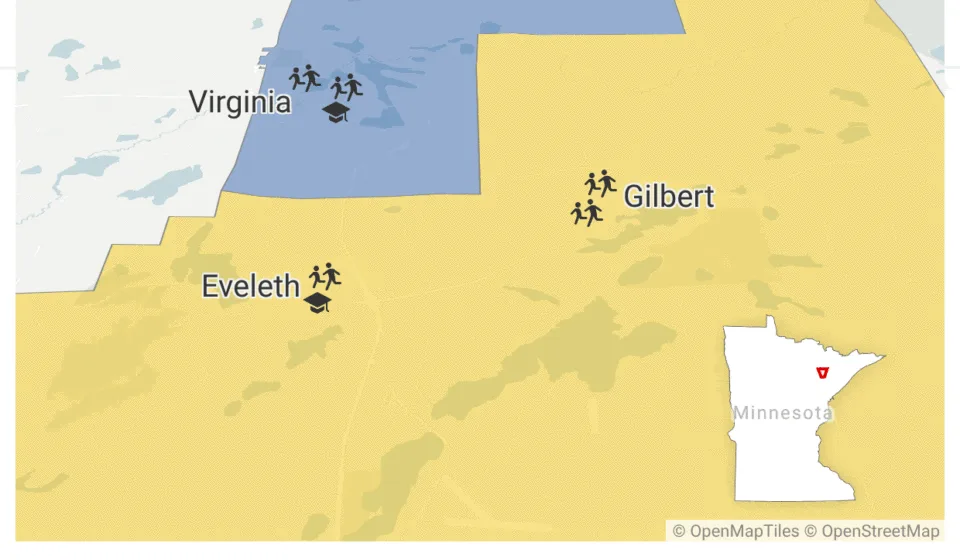
For a decade, the pace of these mergers slowed, but the underlying issues never vanished—they merely festered. Today, the same forces are flaring up. The recent merger of Virginia and Eveleth-Gilbert to form the Rock Ridge School District serves as a modern case study.
The process was not quick. It took years of deliberation and roughly 150 community meetings to shepherd the proposal through. For many, it was a "no-brainer" necessitated by crumbling infrastructure. John Uhan, chair of the Rock Ridge School Board and a former Eveleth-Gilbert board member, recalls that in the final years of the old district, the incoming kindergarten class had dwindled to just 29 students. Simultaneously, a century-old boiler was failing, and roofs were in need of replacement.
"Eveleth-Gilbert would have been in huge trouble," Uhan says. "We had a proud history, but you reach a point where you have to prioritize the future of the kids over the nostalgia of the bricks."
Data-Driven Decisions vs. The Human Cost
The data regarding school consolidation is clear, yet the emotional data is harder to quantify. According to the Minnesota Rural Education Association (MREA), the necessity for change is often driven by the inability to sustain basic operations.
"You need more than just teachers," explains Aaron Fischer, executive director of the MREA. "You need principals, activities directors, custodians, and business managers. Every district, no matter how small, has these needs. When the student count falls below a certain threshold, the cost per pupil becomes unsustainable."

In response, many districts have turned to "soft consolidation"—sharing business services, special education programs, and athletic co-ops. While these measures offer a temporary reprieve, they rarely address the fundamental problem of declining local tax bases and state funding that fails to keep pace with inflation.
The Rock Ridge model, which utilizes a "career academy" approach, is often held up as a success. The new campus boasts modern shops, a 3-ton crane for industrial training, and even a grand piano in the cafeteria. Superintendent Noel Schmidt, who spearheaded the consolidation, argues that this is the only way to remain competitive. "If you’re a rural school, this is what you have to do," he says. "You have to think outside the box."
Official Responses and the "Identity" Conflict
Despite the technological and academic benefits touted by supporters of the Rock Ridge merger, the human cost remains palpable. During a visit to the new campus, one parent, who grew up in the town of Gilbert, expressed deep, profanity-laced frustration. For him, the loss of his local school was a loss of his town’s soul.
"The school was the heart," he said. "When they tore it down, they didn’t just take the building; they took the reason for us to be a community."
This tension between the "practical" and the "sentimental" is what keeps local leaders awake at night. Mayor Adam Roen of Eveleth acknowledges that while the new school offers greater opportunities, the loss of the district building in the town’s center is a profound blow. "When you take the school district out, you take a piece of that identity away," Roen says. "You can create your own, but it’s a different kind of life."
Superintendent Schmidt, however, maintains that waiting to consolidate is a recipe for disaster. "My biggest concern is that rural schools won’t move fast enough," he says. "If we wait for an external factor—like a total fiscal collapse—to force our hand, we’ve already failed the kids."

The Implications for Future Generations
The broader implications of these closures are alarming for the future of rural Minnesota. As schools vanish, the "pull factor" for young families to remain in or move to these regions decreases. The school is the primary engine for social and economic engagement; without it, towns often enter a cycle of rapid decline.
Paul Peltier, now running for the Rock Ridge School Board, emphasizes that the state has a responsibility to recognize this crisis. He argues that there is a growing sense of apathy at the state level. "No one seems to care," he says. "There is a level of fatigue in the Legislature. They’ve heard from us for decades, and they don’t seem to realize that for these small towns, the school is the last, best defense against disappearing entirely."
As districts continue to weigh the costs of survival, the definition of "community" is being rewritten. For the children in Hibbing or the teenagers walking the halls of the new Rock Ridge campus, the future will not be defined by the old buildings their parents attended, but by the new, centralized hubs of innovation that are replacing them.
Whether these new institutions can truly replicate the "anchor" effect of the traditional local school remains the defining question of the era. For now, the process continues: a painful, necessary, and deeply emotional evolution that pits the reality of the future against the memory of the past. As Steve Giorgi, former leader of the RAMS, succinctly puts it: "How do you get from this emotional past to the reality that what the kids need is different? That is a very tough job to do. But eventually, you have to move on."
This reporting is part of a collaboration with the Institute for Nonprofit News’ Rural News Network and Big Local News at Stanford University, with data journalist Cherry Salazar’s analysis helping anchor the reporting. Six nonprofit newsrooms were involved: BenitoLink, KAXE, Mat-Su Sentinel, Mississippi Today, Oxford Free Press, and The Texas Tribune. Support from the Walton Family Foundation made this project possible.