























































A Classroom Under Siege: Minnesota Educators and Districts Sue to Restore ‘Sensitive Locations’ Policy

By [Your Name/Journalistic Staff]
This story was originally reported by The 74, a nonprofit news site covering education.
In an unprecedented escalation of the conflict between federal immigration enforcement and the American public school system, a coalition of Minnesota school districts and the state’s largest teachers union, Education Minnesota, filed a landmark lawsuit in U.S. District Court on Wednesday. The plaintiffs are demanding the immediate reinstatement of a decades-old federal policy that historically barred immigration enforcement activities near schools, churches, and other “sensitive locations.”
The legal challenge, which names Homeland Security Secretary Kristi Noem, the Department of Homeland Security (DHS), Immigration and Customs Enforcement (ICE), and Customs and Border Protection (CBP) as defendants, represents a desperate attempt by educators to reclaim the sanctity of the classroom. For school administrators, the presence of federal agents in parking lots and at bus stops is no longer a theoretical concern; it has become an operational crisis that is destabilizing the educational environment for thousands of children.
The Shift in Federal Policy: A Rapid Deconstruction
The current crisis stems from a sharp pivot in federal strategy. On January 20, 2025—the very day of President Donald Trump’s second inauguration—the longstanding federal guidance protecting schools from routine immigration enforcement was formally repealed.
The administration’s position was framed as a matter of law and order. In a statement released that day, the Department of Homeland Security declared, “Criminals will no longer be able to hide in America’s schools and churches to avoid arrest. The Trump Administration will not tie the hands of our brave law enforcement, and instead trusts them to use common sense.”
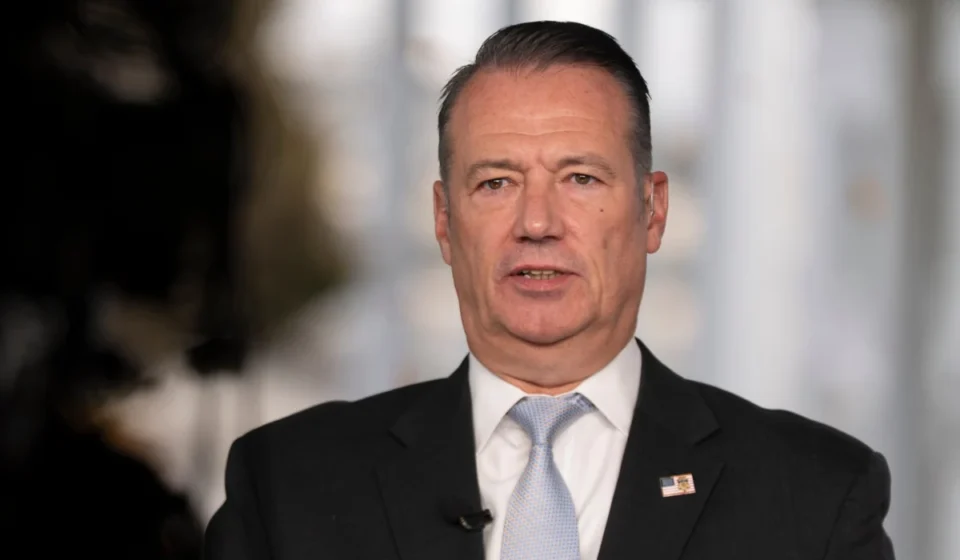
This rhetoric has been echoed by federal officials on the ground. At a press conference in Nogales, Arizona, held on the same day the lawsuit was filed, ICE Director Todd Lyons signaled that the agency would continue its current trajectory. “We didn’t need any new laws,” Lyons told reporters. “We just need the ability to enforce the ones we have.”
Chronology: From Protected Sanctuaries to Frontline Conflict
To understand the gravity of the current situation, one must look at the historical precedent that existed for over three decades. From 1993 until January 2025, immigration agents were required to obtain advance, written approval if they believed exceptional circumstances necessitated an enforcement action near a school. Bus stops, in particular, were explicitly categorized as off-limits to ensure children could travel to and from their studies without fear.
The policy was not merely a procedural guideline; it was rooted in the pedagogical understanding that education requires a foundation of psychological safety. As a 2007 DHS directive noted: “The presence of [ICE] agents conducting investigative activity at schools, or in venues where children’s activities occur, has always been a point of particular sensitivity. Accordingly, it is important to emphasize that great care and forethought be applied.”
This “bedrock principle” was reaffirmed as recently as 2021 by then-DHS Secretary Alejandro Mayorkas, who argued that the agency could effectively fulfill its mission without compromising the basic rights of individuals to access medical care, worship, or education.
The repeal of these protections has led to a rapid deterioration of the school climate in Minnesota:
- January 20, 2025: The “sensitive locations” policy is rescinded by the new administration.
- February 2026: Following a series of raids, the Minneapolis-St. Paul area reports a sharp spike in student absenteeism and the widespread closure of in-person classes in favor of virtual alternatives.
- February 1, 2026: Following international outcry, five-year-old Liam Conejo Ramos is released from a Texas detention center and returned to his home in Columbia Heights, Minnesota.
- February 2, 2026: Despite the high-profile release of the child, ICE agents are reported stationed in school parking lots in the same district, coinciding with a bomb threat, according to Superintendent Zena Stenvik.
Supporting Data: The Cost of Fear
The impact of the federal enforcement surge is quantifiable and devastating. The lawsuit filed by the Minnesota districts details a landscape where schools are increasingly treated as surveillance zones. The complaint documents incidents involving federal agents occupying school parking lots, trailing school board members, and in some reported cases, utilizing force against students and staff.
The effect on attendance has been catastrophic. In Rochester, Minnesota, Superintendent Kent Pekel reported that January absenteeism was 42% higher than the previous month. Among students receiving English learner services, the spike was a staggering 116%, while Latino student absenteeism rose by 108%.
“We know students can’t learn unless they feel safe,” says Duluth Superintendent John Magas. For the Duluth school system, the response has been costly. The district has diverted over $500,000 in staff time and resources toward enhanced security measures and crisis planning. According to Magas, half of the administrative team’s time over the last two months has been dedicated to navigating the instability caused by federal presence, rather than focusing on academic outcomes.
The financial strain is exacerbated by the way Minnesota funds its public schools: revenue is tied directly to daily student attendance numbers. As children are pulled from classrooms by frightened parents, districts face a double-edged sword of rising security costs and plummeting state funding.
Official Responses and the Legal Battle
The lawsuit asserts that the DHS failed to conduct a proper impact analysis before rescinding the sensitive locations policy. By ignoring the educational and community-wide consequences, the plaintiffs argue, the department violated the Administrative Procedure Act and undermined constitutional protections.
While White House border czar Tom Homan has publicly insisted that immigration agents have “de-escalated” their actions and pledged that 700 agents will soon be withdrawn from Minnesota, school leaders remain skeptical. They point out that even with the promised reduction, the remaining force will still exceed the number of agents present during the tragic death of Renee Good, a Minneapolis mother killed by ICE last month.
DHS has largely remained silent on the legal proceedings. As of press time, the department had not responded to requests for comment regarding the specific allegations of intimidation and the disruption of school operations.
Implications for the Future of Public Education
The broader implications of this standoff extend far beyond the borders of Minnesota. If federal agents are permitted to operate with impunity near schools, educators fear a permanent erosion of the "open-door" policy that has defined American public education for generations.
In Rochester, Superintendent Pekel notes that while his schools have not been directly targeted—agents have been in the vicinity, but not on school property—the atmosphere remains fragile. “One incident could wipe that out,” he says, referring to the recent rebound in enrollment.
The lawsuit is being funded not by taxpayer money, but largely through the efforts of Education Minnesota, the teachers union. It is a signal of the desperation felt by the professional staff tasked with protecting children. As the legal battle unfolds, the nation watches a test case for whether the federal government’s enforcement powers can be reconciled with the fundamental right of every child—regardless of immigration status—to walk into a classroom without fear of abduction or state-sponsored intimidation.
For now, the hallways of many Minnesota schools remain quiet, and the empty desks serve as a haunting reminder of the conflict between national border policy and the local obligation to nurture the next generation. As Superintendent Magas poignantly stated regarding the current congressional budget debates, “I’ve heard a lot about body cams and things like that, but I haven’t heard a lot about a return to protected status.”
Until that protection is restored, the schools of Minnesota remain on the front lines of an ideological war, struggling to maintain their identity as sanctuaries of learning in an increasingly volatile political landscape.