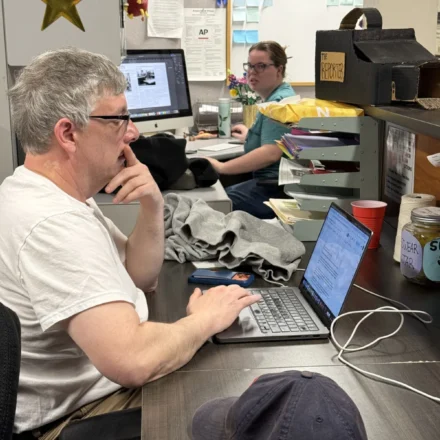



















































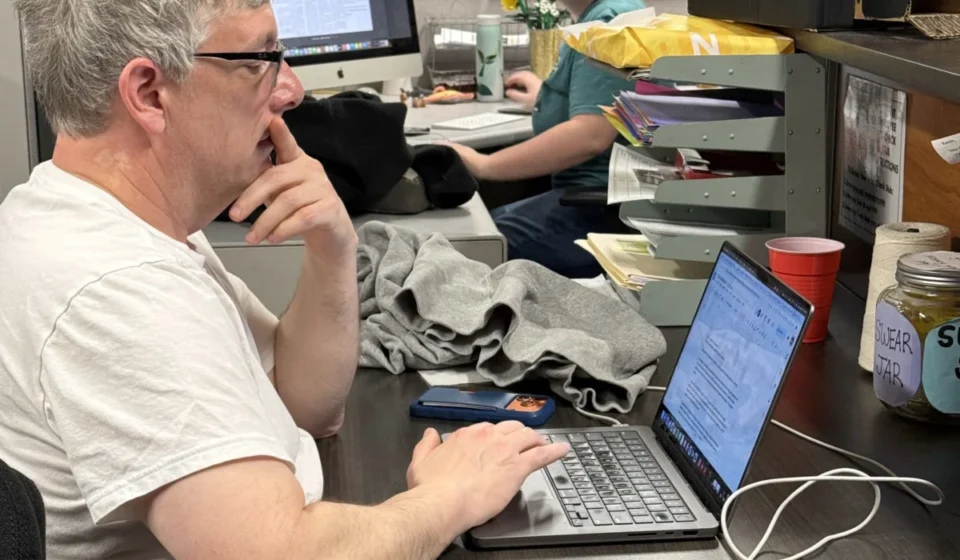

MANKATO, Minn. — One hour before the Monday night deadline at The Reporter, the student-run newspaper of Minnesota State University, Mankato, the atmosphere in the newsroom is focused, bordering on the serene. For Anahi Zuniga, the paper’s editor-in-chief, the adrenaline hasn’t quite hit its peak yet. That, she knows, will come at 8:59 p.m., when the seconds count down to the final transmission of files to the printing press.
For now, however, it is "smooth sailing." Copy is being edited, photos are being cropped, and page layouts are being finalized. Within an hour, Zuniga will hit "send," initiating a mechanical process that will result in physical copies of the paper hitting newsstands across campus by Tuesday morning. The lead story? A deep dive into a proposed 7% tuition hike—a piece of reporting that directly impacts the lives of every student on campus.
As Zuniga watches the final pages land in her digital queue, she reflects on the tangible nature of her work. When she picks up a copy on Tuesday, she isn’t just looking at a layout she designed on a computer screen; she is holding a piece of history. "It’s a satisfying feeling," she says, tracing the margins of the front page. "It keeps history alive."
The Enduring Legacy of Campus Journalism
The Reporter recently celebrated its centennial, marking 100 years of publication. Its longevity is an anomaly in a media landscape defined by rapid contraction, yet it serves as a testament to the resilience of student journalism. Across Minnesota, these publications act as essential training grounds, providing the only space on many campuses where students can grapple with the rigors of professional journalism—writing, copy editing, photojournalism, and the ethical weight of the printed word.
For Zuniga, the experience has been transformative. "I wasn’t very confident with who I was when I first enrolled here," she admits. "I feel so sure of myself now and who I want to be after graduation. I can use my words as a way to express what I feel and think is necessary."
This transformation is common among student journalists. The newsroom serves as a crucible, stripping away the uncertainty of undergraduate life and replacing it with the discipline of the beat reporter.
A Changing Landscape: From Print to Pixels
Despite the romanticism of the printing press, the reality of the newspaper industry is stark. As legacy print outlets shutter or consolidate, college newspapers are being forced to pivot. The trend is clear: many institutions have either seen their papers vanish or migrate entirely to digital-first models.
The transformation is evident across the Minnesota State system and beyond. Bemidji State University’s Northern Student has transitioned from a weekly newspaper to a quarterly magazine. At Minnesota State University Moorhead, The Advocate has moved its primary operations online, printing only once per semester. Meanwhile, Minneapolis College currently lacks a dedicated student newspaper, though student government leaders are in the nascent stages of exploring a revival.
The Reporter remains a holdout, maintaining a twice-weekly print schedule alongside a robust digital presence. Its survival is particularly noteworthy given that the university no longer hosts a formal mass communication department. This suggests that the drive for student journalism is no longer contingent on academic curriculum, but rather on a fundamental student desire to engage with their community.
Supporting Data: The Pulse of the State
A survey of the landscape reveals a fragmented but persistent industry:
- The University of Minnesota System: The Minnesota Daily has successfully transitioned to a digital-only daily, reflecting the realities of the Twin Cities’ fast-paced news cycle. The University of Minnesota-Duluth’s The Bark utilizes a hybrid model, publishing online daily and producing a monthly print magazine. The University of Minnesota-Morris continues to buck the digital trend with its print-only University Register, which publishes bi-weekly.
- The Private College Sector: The Minnesota Private College Council reports that most of its 18 member schools maintain active newspapers. Institutions like the University of St. Thomas (The Crest News), Gustavus Adolphus College (The Gustavian Weekly), Macalester College (The Mac Weekly), and Bethel University (The Clarion) continue to function as the primary record-keepers for their respective campuses.
- The "No-Program" Phenomenon: Perhaps most impressive are papers like The Olaf Messenger (St. Olaf College) and The Carletonian (Carleton College). Both operate at a high level of journalistic integrity despite the absence of formal journalism programs, proving that the appetite for news is intrinsic to the campus experience.
Institutional Perspectives: The Role of the Advisor
For many, the secret to longevity is the guidance of veteran advisors who view the newspaper as an extension of the classroom. Doug Westerman, advisor to The Winonan at Winona State University, views the "natural attrition" of college papers—the constant cycle of seniors graduating and freshmen arriving—as a strength rather than a weakness.

When potential employers call to vet former students, Westerman often jokes about whether he would hire them back. "Well, they graduated. I don’t think they’d want to come back," he laughs.
Behind the humor, however, is a serious commitment to the craft. Westerman argues that the fundamental principles of journalism—sourcing, research, and ethics—are more critical now than ever in an era of information saturation. "You still have to check sources, you still need to do research, whether it’s going on a printed page or going on a post," he says.
The Weight of the Written Word
On March 24, the halls of Minnesota State University, Mankato were filled with alumni returning to celebrate The Reporter’s 100th anniversary. Among the guests was Myron Medcalf, a senior college basketball writer for ESPN and a columnist for the Star Tribune.
Medcalf, who served as the paper’s first African-American editor-in-chief in 2003, delivered a keynote address that underscored the broader societal value of these institutions. "I learned the ins and outs of actually being on deadline, the accuracy that’s necessary in your reporting, the fact that you are communicating to an audience that’s much bigger than you are," Medcalf said. "It’s not about you. It’s about the people who are going to pick up your story and read it."
Medcalf challenged the students to consider the long-term impact of their work. "One-hundred years from now, all of us are gone and what we will have left is what we contributed to this world," he reflected. "A big part of that, no matter what anyone tells you, will be the written word. It’ll be the archives from the MSU Reporter and all of these publications."
Implications: The Future of Campus News
Back in the Reporter office, a week after the centennial celebration, the cycle continues. Editors Addie Larson, Alexis Darkow, Isaac Rozwadowski, and Logan Schlosser sit huddled over monitors, dissecting the week’s news. The editorial independence they exercise is a cornerstone of the operation; they decide what is "news" and what is "noise."
While the students handle the editorial direction, the operation is bolstered by two full-time university staff members: business manager Jane Tastad and production coordinator Dana Clark. Additionally, Robb Murray, an editor at the local Mankato Free Press, provides critical mentorship, proofreading copy and ensuring that the students are adhering to industry standards.
As Monday night winds down and the deadline passes, there is no time for long celebrations. The team gathers in Zuniga’s office, the whiteboard already covered in story ideas for the next edition. They are, as Westerman put it, "chugging along."
For Zuniga, the process is about more than just filling pages. It is about the act of discovery. "We get to have all these very meaningful conversations with classmates and see their thoughts," she says. "I think, overall, working at a college newspaper just opens up a completely different lens on how you view the world."
In an era of digital fragmentation, these newsrooms remain a vital common ground. They are places where young journalists learn that, regardless of the medium, the responsibility to report the truth, to hold power to account, and to document the life of the campus remains the same. As long as there are students willing to ask the hard questions, the campus press will continue to hold its place as an essential, ink-stained pulse of university life.