






















































The Future of Collaborative Development: Slack Unveils "Code Channels" to Democratize AI-Assisted Programming

In a significant move to reshape the software development lifecycle, Slack has introduced "Slack Code," a new feature set centered around "code channels." This innovation transforms Slack from a simple communication tool into a multi-player environment where developers and non-technical staff can collaborate with AI coding agents in real-time. By bridging the gap between project management and technical execution, Slack is positioning itself as the central command center for AI-augmented work.
The Core Concept: A Multi-Player AI Environment
At its heart, Slack Code aims to solve a persistent friction point in modern enterprise: the silos between technical and non-technical teams. Historically, coding agents were isolated, accessible only to engineers working within their own local environments or specialized IDEs. Slack’s new architecture brings these agents directly into the workspace, allowing marketers, product managers, and designers to observe, influence, and approve technical outputs without leaving the platform.
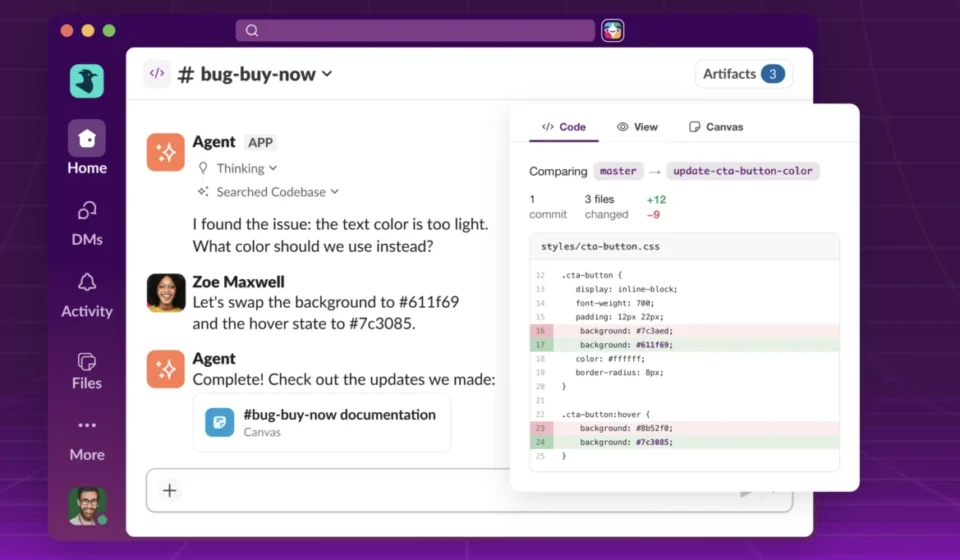
When a team needs to initiate a coding task—whether it’s fixing a specific bug, deploying a new feature, or updating a landing page—they simply tag an AI agent within a standard Slack channel or direct message. The system then automatically spins up a dedicated "code channel." This temporary workspace acts as a sandbox that aggregates relevant documentation, invites key stakeholders, and establishes a secure environment for the agent to operate.
Chronology: Building the AI-Native Workspace
The release of Slack Code is the culmination of a broader strategic pivot by Salesforce-owned Slack to embrace the "agentic" era of AI.
- Early Integration: Over the past year, Slack began integrating third-party AI agents, but these were primarily individual, siloed interactions. Users would interact with an agent one-on-one, creating a "black box" effect for the rest of the team.
- The Shift to Multi-Player: Recognizing the demand for transparency, Slack began developing the "multi-player" infrastructure that would allow multiple humans to interact with a single agent simultaneously.
- The Launch: This week, the company officially rolled out Slack Code, integrating four powerhouse coding agents at launch: Claude Code, Devin, GitHub Copilot, and Vercel.
- The Future Vision: Slack has explicitly stated that this is a foundation. The company plans to expand its roster of compatible agents and eventually port this "multi-player" model to non-coding workflows, such as legal reviews and marketing campaign management.
Supporting Data and Technical Architecture
Slack Code isn’t just a chat room; it is a specialized environment designed for accountability and version control. When an agent is working within a code channel, it generates "session artifacts." These are critical for project visibility and include:
- Code Diffs: Visual highlights that show exactly what lines of code the AI added, removed, or modified.
- Slack Canvases: Integrated documents that house project requirements, technical specs, and context.
- Live Previews: HTML-rendered prototypes that allow non-technical stakeholders to see the AI’s work in a browser-like preview before it is pushed to production.
The platform is designed with "guardrails" in mind. Administrators can configure permissions to ensure that while a marketing manager might be able to suggest a copy change in a web page, the actual "shipping" of that code to the live server remains restricted to authorized engineering personnel. This adheres to Slack’s existing, robust security and permissions model, ensuring that enterprise-grade governance remains intact even as the barrier to technical contribution is lowered.
Official Perspectives: Bridging the Gap
Sateja Parulekar, Vice President of Product Marketing at Slack, emphasizes that this move is about inclusivity. "We built code channels to be this multi-player AI experience and bring more development into Slack," Parulekar noted. "It’s not just engineers and product managers; it’s marketers and product designers who are now able to interact with a coding agent in a safe, governed environment."
Wayne Kurtzman, a Research Vice President at IDC, views this as a vital step for Salesforce’s broader strategy. "Slack Code closes the gap between where work gets done and where code gets written," Kurtzman stated. "This furthers the Salesforce goal of making work more seamless and multi-player within the Slack environment, regardless of the other applications the business is using."
Implications for Enterprise IT and Workflow
The introduction of Slack Code carries profound implications for how organizations will structure their teams in the coming years.
Democratization of Technical Tasks
For years, the phrase "technical debt" has been a barrier to agility. Non-technical staff often have ideas for quick fixes or site updates but lack the bandwidth or skills to execute them. By providing a natural language interface to coding agents within a managed channel, Slack is effectively lowering the barrier to entry for minor technical contributions.
The Security Challenge
While the feature promises efficiency, IT departments are expressing caution. Will McKeon-White, a senior analyst at Forrester, points out that permissions are the "persistent challenge" for any multi-player system. "Some inherit user permissions based on task, some have persistent permissions… Each has flaws," McKeon-White warned. Organizations will need to develop rigorous internal policies regarding which users have the authority to trigger AI agents, especially as those agents gain more "agency" to perform tasks autonomously.
The Rise of Multi-Agent Collaboration
Perhaps the most significant long-term implication is the move toward multi-agent collaboration. Currently, most interactions are "human-to-agent." The next frontier, as highlighted by recent Anthropic research, is "agent-to-agent" collaboration. Imagine a scenario where a "Marketing Agent" and a "Coding Agent" work together in a Slack channel to iterate on a campaign landing page, with humans acting as final editors. While this remains in the early stages, the infrastructure Slack is building provides the necessary stage for this future evolution.
Beyond Coding: The Future of "Agentic" Work
Slack’s ambitions for code channels go well beyond software development. The company sees the "Code Channel" model as a blueprint for any complex, collaborative, document-heavy process.
Consider a legal review. Instead of a messy thread of emails and tracked changes in Microsoft Word, a "Legal Channel" could house a document, an AI agent trained on company compliance guidelines, and a team of stakeholders. The agent could highlight potential risks in real-time, suggest edits based on legal precedents, and track the history of every change made, effectively mirroring the "code diff" workflow used by developers.
Similarly, in marketing, a "Campaign Channel" could allow an agent to pull performance data, suggest ad copy iterations, and generate visual assets, all while the marketing team provides natural language feedback.
Conclusion
Slack’s entry into the AI-agent space is not merely a feature release; it is a fundamental redefinition of the platform’s purpose. By turning Slack into a collaborative, "multi-player" operating system for AI agents, the company is attempting to capture the entire workflow of the modern enterprise.
For software teams, this means faster iterations and better visibility. For non-technical teams, it means the ability to participate in the creation process in ways that were previously impossible. However, as with all AI-driven shifts, the ultimate success of Slack Code will depend on how organizations balance this newfound agility with the stringent security and governance requirements of the enterprise. As first-movers begin to adopt these features, the industry will be watching closely to see if Slack can truly deliver on its vision of an AI-augmented, multi-player workspace.