

























































The Arrival of a New Architect
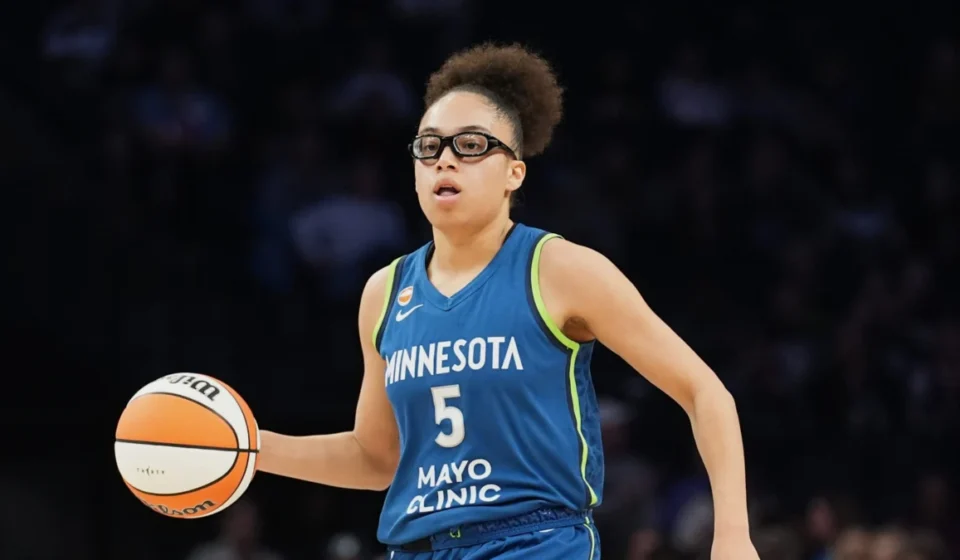
Seven games into her professional career, Olivia Miles walked into the Minnesota Lynx’s press conference room at the Target Center with the relaxed posture of a veteran settling into her own living room. For most rookies, the post-game media gauntlet is an exercise in nerves and rehearsed platitudes. For Miles, it is simply another venue for her natural, high-energy charisma.
Dressed in her game shorts and a black tank top, she paused, shivered, and offered a pointed critique of the climate control. “It’s cold in here!” she quipped. The observation was typical of the flashy rookie point guard: sharp, observant, and impossible to ignore. Moments later, she settled onto the riser next to veteran forward Natasha Howard, playfully tugging at her teammate’s ear—a scene reminiscent of a mischievous younger sister teasing an older sibling. When Howard asked, with a laugh, “What’s wrong with you?” the answer was simple: nothing at all. In fact, everything is going exactly according to plan.
A Rapid Ascent: The Chronology of a Breakout
The trajectory of Miles’ rookie season has been nothing short of meteoric. While her personality won over the locker room early, her play on the court has forced the rest of the WNBA to take notice.
The true turning point arrived just five nights after that press conference in Minneapolis. Facing off against Phoenix, Miles orchestrated a masterclass in basketball IQ and athleticism, fueling the Lynx to a 111-77 demolition of their opponent. Her start was blistering; she opened the game by going 4-for-4 from the field and 3-for-3 from the free-throw line, single-handedly contributing 11 points in the first quarter alone.
By the final buzzer, Miles had recorded 19 points, 10 assists, four rebounds, and three steals. According to team records, that stat line made her the only WNBA rookie other than Caitlin Clark to reach those thresholds in a single game. Yet, the numbers were a poor substitute for the visual reality of her play. Her vision in the third quarter—a threading-the-needle bounce pass between two defenders that allowed Teaira McCowan to finish an easy layup—elicited audible gasps from the Lynx coaching staff on the bench.
Her consistency has been perhaps her most startling trait. Miles opened her career with 10 consecutive games scoring in double figures, eclipsing the franchise rookie record previously held by Naismith Hall of Famers Seimone Augustus and Tonya Edwards. Notably, that record even eluded the great Maya Moore during her storied 2011 debut season.
The momentum continued to build on Thursday night against Golden State. Facing a high-stakes defensive scheme, Miles erupted for a season-high 28 points, including a WNBA rookie-record eight three-pointers—a staggering turnaround for a player who had only converted two of 18 attempts from deep in her previous outings. As of the following Saturday, Miles stood atop all WNBA rookies in scoring (17.0 PPG), assists (6.4 APG), steals (1.5 SPG), and minutes (30.4 MPG). It came as little surprise when she was named the WNBA Rookie of the Month for May, solidifying her status as the early frontrunner for Rookie of the Year honors.
Supporting Data: Why the Chemistry Works
The success of the Lynx, who currently boast a league-best 8-2 record and a dominant 13.0 net rating, is built upon a foundation of tactical flexibility and unselfishness. This is a team that navigated a volatile offseason, losing key pieces in the expansion draft and free agency, yet they have arguably emerged stronger.
The synergy between Miles and veteran forward Natasha Howard has been the heartbeat of the Lynx offense. Howard, a 13-year veteran, has noted that the chemistry she shares with the rookie is an anomaly. "It’s unbelievable," Howard remarked. "She sees things before they happen. She’s got in her head what she wants to do before the play even starts."
Howard, who has played alongside legendary floor generals like Sue Bird, Sabrina Ionescu, and Lindsay Whalen, puts Miles in elite company. The tactical "cerebral" nature of Miles’ game allows the veteran-heavy roster to play with a fluidity that most teams take years to develop. Miles herself credits the culture of the team for this rapid integration. "I came into the W kind of scared of stepping on toes," Miles admitted. "But it was so easy. The culture, people just want to win. There are absolutely no egos."
Official Perspectives: The Coaching Consensus
Head coach Cheryl Reeve, a veteran of the league’s most intense coaching battles, has taken a "let her fly" approach to the rookie’s development. Despite a high-risk attempt against Atlanta where Miles tried to thread a bounce pass through an opponent’s legs, Reeve remains committed to fostering the point guard’s authentic style of play.
"I want her to be herself, her confident, authentic self," Reeve stated. "If there’s something we don’t like, then we’ll share it, but we want her to be herself. If I see something, I might yank her back a little bit. But in general, I want her to go."
This sentiment is echoed around the league. Sandy Brondello, the head coach of the Toronto Tempo and a seasoned championship-winning strategist, offered high praise for the rookie. "We knew she was always going to be a great player in this league," Brondello noted. "She’s a generational point guard. We haven’t had many for a while. Her ability to pass in the pick and roll, her willingness to get downhill—she’s a great young talent to build around."
Lindsay Whalen, the Naismith Hall of Famer and Lynx assistant coach, expressed a similar level of awe. "I think she’s a better passer than I was," Whalen admitted. "Especially in those windows she’s able to find. Her ability to put pressure at the rim is something that can take people time, but she’s done a really good job of getting herself in those positions where she can finish or kick out."
Implications: Building a New Dynasty
The emergence of Olivia Miles carries significant weight for the future of the Minnesota Lynx. In an offseason where many analysts questioned the team’s direction—particularly after the departure of key defensive contributors and uncertainty surrounding star Napheesa Collier—Miles has effectively rewritten the narrative.
The decision to draft Miles rather than a traditional frontcourt anchor like UCLA’s Lauren Betts was initially met with skepticism by some observers. However, the current results confirm a fundamental truth of professional basketball: an elite, high-IQ point guard can elevate every other player on the roster.
By allowing Courtney Williams to slide back to her natural position on the wing and utilizing Miles as the primary facilitator, the Lynx have created a balanced, lethal starting lineup. Miles has provided the team with an identity that is both exciting and deeply disciplined. She brings an "East Coast confidence" that has become a defining characteristic of this iteration of the Lynx—a team that thrives on the unexpected.
As the season progresses, the league will inevitably adjust to Miles’ tendencies. Defensive schemes will tighten, and scouting reports will become more granular. Yet, the consensus remains that Miles possesses the rare combination of physical talent and mental processing speed required to sustain this level of excellence.
For the Minnesota Lynx, the "cold" press conference room is a small price to pay for the "heat" Miles is bringing to the court every night. As Coach Reeve succinctly put it: "You can call her a rookie if you want to. She’s just always ready for the moment." Whether she is pulling off a highlight-reel no-look pass or calmly leading the team through a high-pressure fourth quarter, Olivia Miles has already proven that the moment is exactly where she belongs.