






















































In the mid-20th century, the American cultural landscape was dominated by monolithic, often derogatory, portrayals of Indigenous peoples. Native Americans were relegated to the margins of cinema and literature, appearing as nameless antagonists in Westerns or exoticized relics of a vanishing past. Into this void stepped Patrick DesJarlait (Red Lake Nation), a visionary modernist painter who refused to let his people be defined by the gaze of others.
DesJarlait, known to his community by his Ojibwemowin name Nagawbo ("Boy in the Woods"), emerged as a vital bridge between traditional storytelling and the commercial art world. His work did more than merely depict the Red Lake Ojibwe; it imbued their daily lives with a heroic, dignified aesthetic that challenged the prevailing stereotypes of his era. From the iconic imagery of the Land O’Lakes butter maiden to the whimsical animation of the Hamm’s Beer bear, DesJarlait’s influence permeated American pop culture, even as his fine art worked to preserve the soul of the Anishinaabe.

The Foundations of an Artist: Early Life and Resilience
Born on March 2, 1921, on the Red Lake Reservation in northern Minnesota, DesJarlait’s life was defined by both hardship and creative discovery. His early childhood was marked by a profound connection to the natural world; he spent his days observing the rhythms of the forest, sketching animals and the seasonal labor of his relatives. His talent was recognized early, earning him the moniker Gwiwizens Odayn Ozhibii’ignaak—"Boy with a Pencil."
However, his path was far from easy. At age five, he battled trachoma, a painful eye infection that left him temporarily blind. His recovery, while miraculous, was followed by the systematic trauma of the federal Indian boarding school system. At St. Mary’s and later at the Pipestone Indian School, DesJarlait endured an environment that explicitly prohibited the practice of Ojibwe culture, language, and dance. The loss of his mother when he was just seven years old further compounded the isolation he felt within the colonial education apparatus.

Despite the lack of formal art training in his high school years, the intervention of his English teacher, Dorothy Ross, proved pivotal. She nurtured his creative impulses, eventually helping him secure a Bureau of Indian Affairs scholarship to attend Arizona State College in 1940. This academic pursuit was short-lived, interrupted by the global upheaval of World War II.
A Chronology of a Creative Life
The trajectory of DesJarlait’s career reflects the shifting status of Native Americans in 20th-century America:

- 1940–1942: Attends Arizona State College, developing his modernist style.
- 1942: Leaves school to accept a position as an art supervisor at the Poston War Relocation Center in Arizona, where Japanese Americans were incarcerated—a period that offered him unique insights into the intersection of race, policy, and human rights.
- 1942–1945: Serves in the U.S. Navy in San Diego, producing training and propaganda films, honing his technical skill in commercial media.
- 1945: Holds his first solo exhibition at the Fine Arts Gallery in San Diego; the collection sells out in a single week.
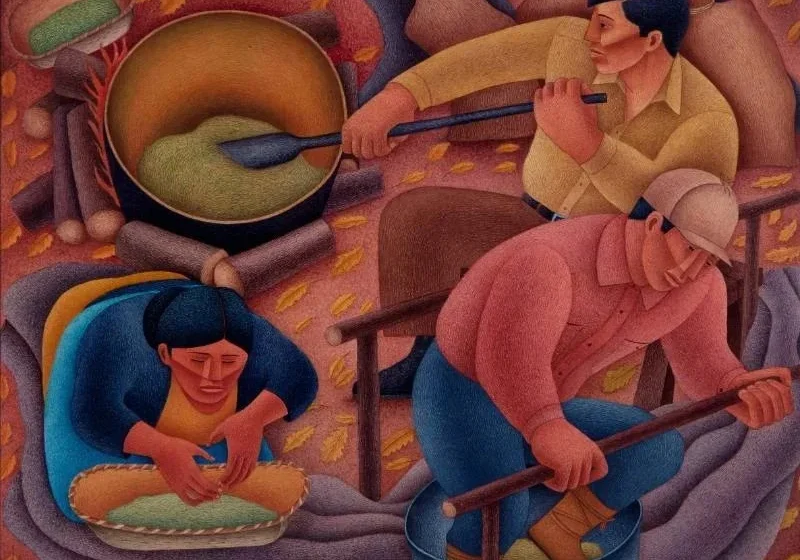
- 1947: Relocates to St. Paul, Minnesota, and produces a series of definitive works, including "Maple Sugar Time," "Red Lake Fishermen," and "Making Wild Rice."
- 1954: Executes the landmark redesign of the Land O’Lakes butter maiden, integrating authentic Ojibwe beadwork and cultural motifs.
- 1968–1972: Aligns his artistic mission with the burgeoning sense of pride and political consciousness fostered by the American Indian Movement (AIM).
- 1972: Passes away at age 51 due to cancer-related complications, leaving behind a legacy that continues to inform contemporary Indigenous art.
The Commercial Genius: Reimagining the "Indian Maiden"
DesJarlait’s commercial work is perhaps his most recognizable contribution to American visual culture, though its nuance is often overlooked. In 1954, he was tasked with revising the Land O’Lakes butter maiden. At the time, the branding was a generic, colonial fantasy of Native life. DesJarlait, drawing upon his heritage, transformed the figure.
He incorporated detailed Ojibwe beadwork patterns onto her dress, providing a cultural accuracy that had previously been absent. Most notably, he repositioned the "O" in the logo, framing it behind the maiden’s head like a Byzantine halo. By doing so, he elevated the figure from a decorative object to an icon, subtly asserting the sacred nature of the Indigenous presence. This work was not just an advertising job; it was an act of subversion, placing authentic Anishinaabe markers into the heart of mainstream American commerce.

Supporting Data and Artistic Philosophy
DesJarlait’s approach to painting was rooted in a "heroic" style—a blend of modernist simplification and traditional realism. He intentionally moved away from the "vanishing race" tropes that dominated Native art at the time. Instead, he painted families, laborers, and community members engaged in the vibrant, ongoing work of living.
His commitment to "Indian Education"—the title of a 1970 painting—was the culmination of his philosophy. During the late 1960s, as the American Indian Movement gained momentum, DesJarlait found himself in a position of mentorship. He wanted to counter the negative portrayals of Native fathers and families in the media. His final years were spent speaking in schools and colleges, emphasizing that the "Indian experience" was not a relic of the past, but a living, breathing reality that deserved the same respect and representation as any other American narrative.

Implications for Modern Native Art
The legacy of Patrick DesJarlait extends far beyond the canvas. He proved that an Indigenous artist could navigate the complexities of commercial advertising while maintaining a deep, unyielding commitment to their community. His ability to blend the commercial with the profound served as a blueprint for subsequent generations of Native artists who seek to reclaim their narrative in mass media.
The "Red Lake School" of art, which DesJarlait helped define, continues to influence how the Ojibwe are depicted today. By prioritizing the dignity of his subjects, he helped shift the discourse from pity or curiosity to one of respect and cultural sovereignty.

Official and Historical Perspectives
The significance of DesJarlait’s work has been formally recognized by institutions like the Philbrook Museum of Art, which awarded his work top honors in 1947. However, the true weight of his impact is felt in the archives of organizations like MNopedia and the Minnesota Historical Society, which continue to preserve his sketches and paintings as essential components of Minnesota’s cultural history.
Contemporary scholars note that while DesJarlait was never a member of the American Indian Movement, his work provided the visual language for the pride that the movement fought to instill. He understood, perhaps better than anyone of his generation, that the battle for identity is fought in the classrooms, the ad agencies, and the art galleries alike.

Conclusion: A Living Legacy
Patrick DesJarlait’s life was tragically brief, yet his output was immense. He left behind a body of work that serves as a permanent record of the Red Lake Ojibwe people at a time of profound transition. Whether through the bold lines of his commercial advertisements or the delicate watercolor of his woodland scenes, DesJarlait insisted on a simple, revolutionary truth: that the Indigenous people of the Great Lakes were not disappearing. They were here, they were working, they were raising families, and they were the rightful architects of their own representation.
Today, as we view his works—such as the evocative "Maple Sugar Time"—we are not looking at historical artifacts. We are looking at a vision of humanity that refuses to be diminished. Nagawbo may have started as a boy with a pencil in the woods of Red Lake, but he ended as a giant of American art, a man who gave his people back their image and taught a nation how to truly see.