























































The Visionary Legacy of Patrick DesJarlait: Reclaiming the Indigenous Narrative Through Modernist Art

In the mid-20th century, the American cultural landscape was dominated by caricatures. Indigenous peoples were frequently relegated to the fringes of the national consciousness—depicted as silent sidekicks in Western films, nameless archetypes in advertising, or tragic figures of a "vanishing" past. Amidst this era of profound misrepresentation, Patrick DesJarlait (Red Lake Nation) emerged as a transformative force, wielding his brush to challenge stereotypes and assert the dignity, continuity, and vibrant complexity of the Ojibwe people.
A pioneer of Native American modernism, DesJarlait’s life was defined by resilience. From the corridors of federal boarding schools to the high-stakes world of Twin Cities advertising, he navigated two worlds while refusing to surrender his cultural identity. Today, he is remembered not only for his iconic commercial contributions—such as the redesign of the Land O’Lakes butter maiden—but for his foundational role in documenting the living, breathing reality of the Red Lake Ojibwe.

A Life Forged in Resilience and Observation
Born on March 2, 1921, on the Red Lake Reservation in Minnesota, Patrick DesJarlait entered the world with an innate inclination toward visual storytelling. His Ojibwemowin name, Nagawbo ("Boy in the Woods"), spoke to his early connection with the natural world. Long before he was formally recognized as an artist, he was a keen observer, sketching the woodland creatures and the rhythmic daily life of his community. His elders eventually bestowed upon him the name Gwiwizens Odayn Ozhibii’ignaak—"Boy with a Pencil."
However, his youth was marked by systemic hardship. At age five, he contracted trachoma, an infection that left him temporarily blind. Though he eventually regained his sight, the ordeal was merely the prelude to a more permanent separation. He was funneled into the federal boarding school system, an environment explicitly designed to strip Indigenous children of their language, traditions, and heritage. At St. Mary’s and later the Pipestone Indian School, DesJarlait faced a world where Ojibwe crafts, games, and dances were strictly forbidden.

Despite the loss of his mother when he was seven and the trauma of cultural displacement, DesJarlait found an unlikely ally in his high school English teacher, Dorothy Ross. Recognizing his talent, she encouraged his artistic pursuits at a time when formal art education was unavailable to him. This encouragement served as a bridge to his future, allowing him to secure a Bureau of Indian Affairs scholarship to Arizona State College in 1940.
Chronology: A Trajectory of Artistic Evolution
The arc of DesJarlait’s career reflects the broader evolution of 20th-century American art, moving from academic discipline to commercial mastery and, ultimately, to cultural activism.

- 1921–1935: Early Years and Education. Born at Red Lake; attended St. Mary’s and Pipestone Indian School. Developed his foundational skills in sketching despite an oppressive boarding school environment.
- 1940–1942: Collegiate Aspirations. Attended Arizona State College. This period exposed him to new aesthetic techniques, though his studies were interrupted by the onset of World War II.
- 1942–1945: The War Years. After a brief stint as an art supervisor at the Poston War Relocation Center (a Japanese concentration camp), he enlisted in the U.S. Navy. He served in San Diego, where he gained experience in film and propaganda production—skills that would later define his commercial career.
- 1945: The Breakthrough. His first solo exhibition at the Fine Arts Gallery in San Diego was a resounding success, with his entire collection of Ojibwe-themed paintings selling within a week.
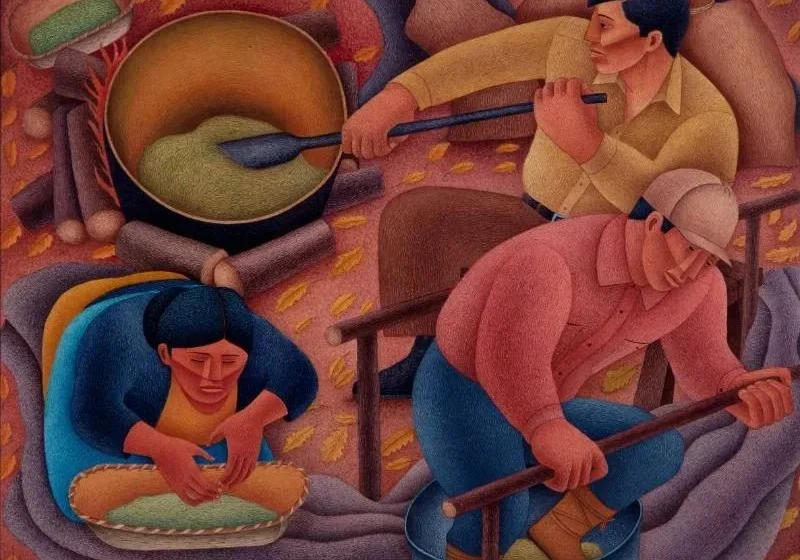
- 1947: Establishing the Legacy. Relocating to St. Paul, Minnesota, he produced his most critically acclaimed works: "Maple Sugar Time," "Red Lake Fishermen," and "Making Wild Rice." The latter won first prize at the Philbrook Indian Annual.
- 1954: The Commercial Icon. He redesigned the Land O’Lakes butter maiden, integrating Ojibwe beadwork and aesthetic elements into the logo, effectively reclaiming a corporate symbol through Indigenous design.
- 1968–1972: The Final Chapter. As the American Indian Movement (AIM) emerged, DesJarlait’s work shifted toward a more overt educational focus, culminating in his 1970 series, "Indian Educations," aimed at instilling pride in the next generation.
- 1972: DesJarlait passed away at the age of 51, leaving behind a profound legacy of artistic resistance.
The Intersection of Commercial Art and Cultural Identity
DesJarlait is perhaps best known to the general public for his work in the advertising industry. While critics might dismiss commercial art as purely utilitarian, DesJarlait treated it as a canvas for cultural visibility. His 1954 revision of the Land O’Lakes logo is a testament to this approach. By meticulously adding Ojibwe floral beadwork designs to the maiden’s dress and adjusting the typography to evoke a Byzantine-like halo, he subtly forced a corporate icon to reflect an Indigenous reality.
His work with Reid Ray Films and Campbell-Mithun, particularly on the Hamm’s Beer bear commercials, demonstrated his versatility. By incorporating Northern Woodland references into these animations, he embedded his cultural heritage into the bedrock of American consumer culture. He proved that an Indigenous artist could navigate the professional demands of Madison Avenue without sacrificing the aesthetic integrity of his origins.

Implications: The Moral Imperative of Representation
The significance of DesJarlait’s work cannot be separated from the sociopolitical climate of the mid-20th century. During the 1940s and 50s, the "Cowboy and Indian" narrative was at its zenith in Hollywood and literature. By contrast, DesJarlait’s paintings—such as "Maple Sugar Time"—offered a radical counter-narrative. He depicted the Red Lake Ojibwe not as historical relics, but as a living, working, and thriving community.
His shift in the late 1960s to create "Indian Educations" was a deliberate move to address the burgeoning urban Native experience. He understood that young Indigenous people in cities like Minneapolis were being bombarded with negative imagery and systemic discrimination. His paintings of loving, active Native fathers and families were not merely portraits; they were acts of resistance against the erasure of the Indigenous family unit.

Academic and Historical Perspectives
Historians and art critics today categorize DesJarlait as a bridge between traditional Native art forms and the modernist movement. Unlike some of his contemporaries who favored the "Studio Style" (characterized by flat, two-dimensional planes), DesJarlait’s work often utilized bold lines and a deep, empathetic realism.
According to MNopedia, his contribution is best measured by his role as an educator. In his later years, he frequented public schools and universities, viewing the classroom as an extension of the studio. He recognized that for the Ojibwe to thrive, non-Indigenous Americans had to unlearn their prejudices. He acted as a cultural translator, using his art to force conversations about the realities of reservation life, the legacy of boarding schools, and the inherent strength of the Ojibwe people.

Conclusion: An Enduring Vision
Patrick DesJarlait’s life was cut short by cancer in 1972, but the seeds he planted continued to grow long after his passing. He died just as the Native American art movement was beginning to receive widespread institutional recognition, leaving behind a blueprint for how Indigenous artists could achieve professional success without assimilating into the Western gaze.
Today, as we look back at the watercolor scenes of "Maple Sugar Time" or the intricate details of his commercial designs, we see more than just art. We see the hand of a man who was, in his own words, a "Boy with a Pencil"—someone who took the power of observation and turned it into a weapon against invisibility. His legacy reminds us that art is not merely an aesthetic endeavor; it is a vital tool for survival, identity, and the reclamation of a stolen narrative. Whether through his commercial icons or his heartfelt portrayals of his people, DesJarlait ensured that the story of the Red Lake Ojibwe would not just be told, but would be seen with the dignity and complexity it deserves.