




















































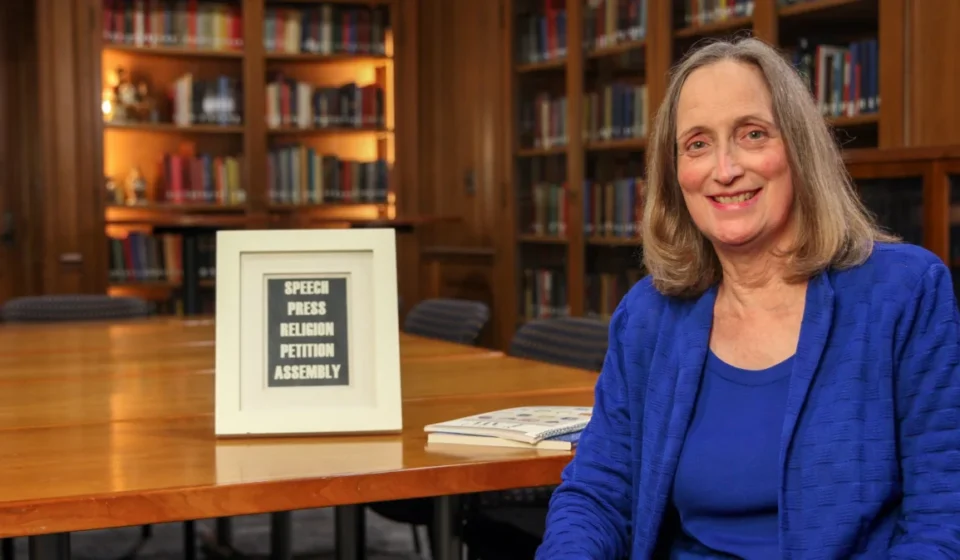

On May 25, the University of Minnesota’s Hubbard School of Journalism and Mass Communication will bid farewell to one of its most formidable intellectual pillars. Jane E. Kirtley, the Silha Professor of Media Ethics and Law, is stepping down, marking the end of a career that has served as a primary bulwark for the First Amendment in the United States. For decades, Kirtley has been the definitive authority on freedom of information, a trusted voice for international media, and a relentless watchdog against the erosion of press freedoms.
Her departure comes at a precarious moment for American journalism, a field currently grappling with existential threats ranging from judicial hostility and corporate consolidation to the encroaching influence of artificial intelligence. As she prepares to transition into retirement, Kirtley leaves behind not just a legacy of scholarship, but a stark warning about the fragility of the democratic institutions she spent a lifetime defending.
A Career Defined by Advocacy
Before her tenure at the University of Minnesota began in 1999, Kirtley spent 14 years as the executive director of The Reporters Committee for Freedom of the Press in Arlington, Virginia. This role placed her at the epicenter of legal battles involving journalists’ rights to gather and report the news without government interference. Prior to that, she honed her legal acumen during a five-year stint at a prestigious law firm in New York and Washington, D.C.
Throughout her career, Kirtley has functioned as a "lawyer’s lawyer" for the newsroom, providing essential guidance on libel, reporter privilege, and the nuances of the Freedom of Information Act (FOIA). Her work has bridged the gap between abstract constitutional theory and the boots-on-the-ground reality of investigative journalism.
The Calculus of Retirement: Why Now?
At 72, Kirtley admits that the decision to retire was not made lightly. She first considered the transition in late 2019, following the retirement of her husband, Stephen Cribari, a law professor at Notre Dame. However, the onset of the COVID-19 pandemic—and the subsequent cessation of travel—rendered the idea of retirement less appealing.
In the years that followed, her sense of duty compelled her to stay. She explicitly delayed her departure to witness and analyze the legal challenges presented by the second Trump Administration. However, the passing of her predecessor, Don Gillmor—the founding director of the Silha Center, who died in 2013 shortly after his own retirement—left a profound impression on her.
"You just can’t take for granted you can keep doing the things you care about doing," Kirtley noted, reflecting on her desire to return to international teaching, including experiences like her Fulbright residency in Riga, Latvia. "I want to make sure I’m healthy enough to do it."
The Weaponization of Law: A New Era of Hostility
In an interview regarding the state of the press, Kirtley articulated a sobering view of the current landscape. She suggests that while journalism has always faced pressure, the nature of the current threat is fundamentally different.
The Erosion of Libel Protections
Kirtley identifies the potential overturning of the New York Times v. Sullivan standard as the single greatest threat to the stability of the American press. Since 1964, this landmark ruling has required public officials to prove "actual malice" in libel suits, a standard that protects journalists from being silenced by the deep pockets of powerful figures.
"In the 1980s and ’90s, there was speculation about whether the Supreme Court would overrule Sullivan," Kirtley explained. "It never happened. Now, I think we have reason to be very concerned. The current court has demonstrated a willingness to reverse long-standing precedent, and the staying power of Sullivan is no longer guaranteed."
The Rise of Novel Legal Attacks
Beyond libel, Kirtley observes a shift toward using consumer fraud statutes and other "novel legal theories" to penalize media outlets. This strategy, she argues, is being led by political figures who aim to treat news organizations not as constitutionally protected entities, but as commercial targets for litigation.
The Corporate Shift and the "Silicon Valley" Influence
Kirtley expresses deep concern over the change in ownership models within the media industry. She notes that the transition from mission-driven legacy owners—like the Sulzbergers or the Grahams—to venture capitalists and tech-focused owners has fundamentally altered the purpose of news.
"Many of the owners of media outlets today do not see them as vehicles for serving the public interest," she said. "They see them as means for wielding power or maximizing profit. Even William Randolph Hearst understood the purpose and need for a free press in this country to hold the powerful accountable. I don’t get even a hint of that from many of the current mainstream media owners."
The Credibility Gap: From Watergate to the Silo Era
Perhaps the most damaging development, according to Kirtley, is the systematic, multi-generational undermining of the public’s trust in journalism. She traces this back over 40 years, noting that both the left and the right have participated in eroding the stature of the mainstream press.
"In the post-Watergate era, bright young people wanted to go to college to become the next Woodward and Bernstein," Kirtley recalled. "That confidence that you were getting truthful, accurate reporting has been undermined quite deliberately."
This erosion has made it easier for modern political actors to label inconvenient reporting as "fake news." In an era of digital silos, where audiences can curate their own reality, the ability for journalists to document and verify facts is increasingly rendered moot by a public that prefers to stay within their own ideological echo chambers.
The "Devil’s Tool": AI in the Newsroom
Kirtley is candidly pessimistic about the role of Artificial Intelligence in journalism. She views AI as a significant threat to the intellectual rigor of the profession.
"I hate AI. To me, it’s the devil’s tool," Kirtley stated. "I don’t feel able to train my students in how to use it. I would feel complicit in a plot to undermine values that matter to me, like accuracy and critical thinking."
She points to the trend of newsrooms using AI to rewrite or generate stories—a practice she believes eliminates the vital role of the copy editor. "AI is not going to ask, ‘Who are you talking about, and how do you know this?’ It’s just going to process what you feed into it. The product is going to be imperfect."
Implications: The FCC and the New Regulatory Climate
Kirtley’s final warnings extend to the current regulatory climate, specifically the actions of the Federal Communications Commission (FCC) under Chairman Brendan Carr. She describes his targeting of broadcast networks that host political satire and criticism of the President as "the most blatantly political" use of the agency in modern history.
"What we’re seeing now with Brendan Carr is that his regulatory activity seems motivated by trying to discourage any kind of speech that criticizes the administration," she said.
While the FCC has long held authority to regulate "indecent" speech via the safe harbor doctrine, Kirtley emphasizes that such power was never intended to be used for viewpoint discrimination or political retribution. This expansion of regulatory power, coupled with the potential for the Supreme Court to revisit established media law, creates a volatile environment for the future of broadcast news.
Conclusion: A Call to Vigilance
As Jane Kirtley steps away from the lectern, she leaves behind a profession in flux. Yet, she remains optimistic about the next generation of journalists. She notes that despite the lack of financial incentives and the rise of digital threats, many young people still possess a "burning desire" to hold the powerful to account.
Her final message is one of necessity: the survival of the American experiment depends on a press that is free, skeptical, and protected by the law. Whether the industry can resist the combined pressures of artificial intelligence, judicial instability, and political weaponization remains the defining question of the decade. For those who follow in her footsteps, Kirtley’s career serves as a blueprint for how to hold the line.