




















































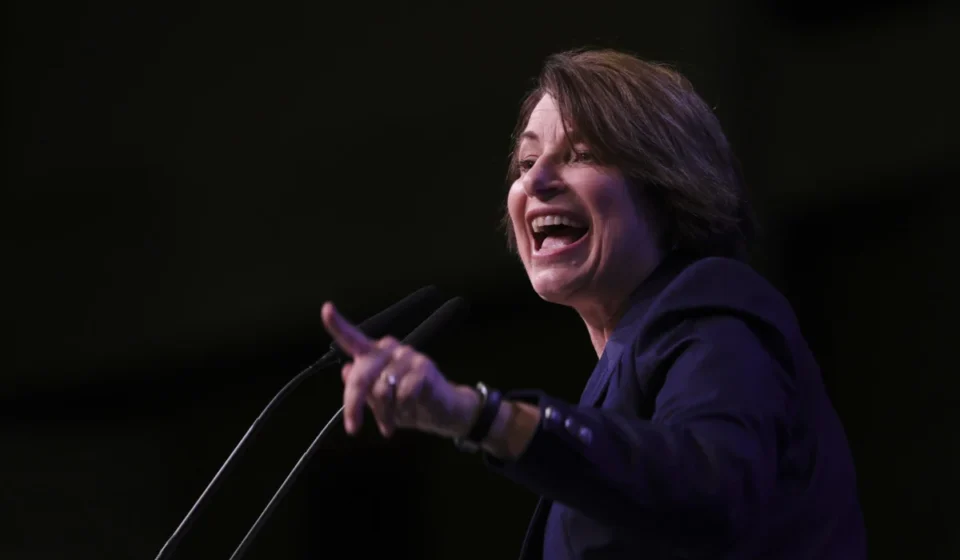

WASHINGTON D.C. – In a pivotal political realignment for Minnesota, U.S. Senator Amy Klobuchar has answered the Democratic Party’s urgent call, stepping away from a distinguished career in Washington to seek the governorship of her home state. Her decision, coming after Governor Tim Walz unexpectedly announced he would not pursue a third term, has reshaped the state’s political landscape and positioned Klobuchar as the heavily favored candidate to become Minnesota’s first female governor.
"I truly do love my job in the Senate, but I love my state more than any job and I believe that we can get to a better place," Klobuchar declared, articulating a deep-seated commitment to Minnesota that overrides her considerable influence on Capitol Hill. Her dissatisfaction with the prevailing political climate is clear: "I don’t like the status quo." This sentiment underpins her ambitious agenda, which includes a comprehensive 40-point plan aimed at reforming state government and a firm commitment to addressing any allegations of fraud. Characteristically, Klobuchar also signaled her intent to rapidly implement these changes, stating, "Patience is a virtue, but it’s one I don’t have."
The Call to Service: A Swift and Unexpected Turn
Klobuchar’s entry into the gubernatorial race was prompted by a sudden and unforeseen development in early January. Governor Tim Walz, after weeks of speculation, reversed course and decided against running for a third term, giving Klobuchar just a single day’s notice of his decision. This abrupt opening sent ripples through the state’s political establishment and triggered a flurry of calls to Klobuchar from both state DFLers and national Democrats, urging her to consider the race.
"I’d been saying, ‘Maybe you could wait two weeks,’" Klobuchar recalled, reflecting on the compressed timeline. Despite the pressure, she herself waited a fortnight before officially filing as a gubernatorial candidate, a period likely spent in careful deliberation and consultation. Her decision was not made lightly, as she acknowledged, "there were a lot of people in the Senate that made the case for me to stay there." However, the senator ultimately felt a unique pull toward her home state. "But I think people understood the unique moment we were in as a state and why I made that decision," she explained, hinting at a confluence of factors that necessitated her pivot.
The "unique moment" Klobuchar refers to is underscored by a series of recent tragedies and challenges that have gripped Minnesota. She cited the "horror" of incidents such as the murders of former Minnesota House Speaker Melissa Hortman and her husband, the devastating mass shooting at Annunciation Catholic School, and the deaths of Renee Good and Alex Pretti during a federal operation, "Operation Metro Surge." These events, she stated, profoundly influenced her decision. "I’ve always believed that we could get to higher ground and it’s been one thing after another that’s made that hard in Minnesota," she lamented, framing her campaign as a mission to restore stability and trust.
From Capitol Hill to State Capitol: A Shift in Power Dynamics
Klobuchar, 66, departs Washington as a formidable figure within the Democratic Party. A member of Senate Democratic leadership, she leveraged her seniority, strategic acumen, and renowned grit to ascend to the No. 3 spot as chair of the Steering and Policy Committee. Her departure represents a significant loss of influence for Minnesota in the national legislature, a point not lost on her colleagues.
Senator John Hoeven, a Republican from North Dakota who has frequently collaborated with Klobuchar on regional issues, offered insight into her potential motivations. He suggested that Klobuchar might have been weighing her future trajectory within the Senate’s hierarchical structure. "She had to weigh, ‘Do I stay and see how that plays out or do I go back to Minnesota?’" Hoeven mused, highlighting the inherent tension between national ambition and local service.
Political science professor Tim Lindberg of the University of Minnesota Morris provided further academic perspective, suggesting that Klobuchar may have experienced frustration with the persistent gridlock characterizing a closely divided Senate. The filibuster rule, which often necessitates 60 votes to advance legislation, frequently impedes initiatives, regardless of which party holds the majority. "Being governor allows her to be in a power position where she can do things and make big changes," Lindberg observed, articulating the allure of executive authority after years navigating legislative stalemates.
Lindberg also emphasized the strategic advantages Klobuchar enjoys in this race. The existence of an open seat, combined with her early entry, effectively "eclipsing all other possible (Democratic) contenders," positioned her as the undisputed frontrunner from the outset. In a testament to her widespread appeal and political strength, Klobuchar recently selected former Fergus Falls Mayor Ben Schierer as her lieutenant governor candidate, signaling a focus on both urban and rural representation.
A Track Record of Bipartisanship and Relentless Work Ethic
Having represented Minnesota in the U.S. Senate since 2007, Klobuchar is a well-established political figure, a "known commodity" with a reputation forged over decades of public service. She is widely regarded as a moderate Democrat, yet one unafraid to challenge powerful interests, including the pharmaceutical industry and tech giants, albeit with a pragmatic approach. Her work ethic is legendary on Capitol Hill, where she is known as a tireless advocate, a trait she candidly admits can often wear out her staff.
Crucially, Klobuchar has consistently distinguished herself through her exceptional ability to forge common ground with Republicans, a rare commodity in today’s polarized political climate. "I’ve always focused on getting things done," she affirmed, reflecting on her legislative philosophy. "There’s this moment in time that is not going to be like any other where we’ve been facing hard things and I want to make sure that we stay together as a state, despite the political divides and changing the status quo and not just accepting things and restoring people’s trust in our government again."
Senator Tammy Baldwin, a Democrat from Wisconsin, who collaborated with Klobuchar on various regional initiatives, attested to her effectiveness. "When she’s trying to persuade a colleague on an issue, she’s really prepared," Baldwin said. "She also has the instinct to know where an agreement can be forged." This capacity for diligent preparation and strategic negotiation has been a hallmark of Klobuchar’s Senate tenure.
Her commitment to connecting with constituents is equally remarkable. Born in Plymouth, Klobuchar maintains a grueling travel schedule, visiting every single county in Minnesota annually. "That means to me she knows every corner of the state and she has her finger on the pulse," Baldwin noted, highlighting Klobuchar’s deep understanding of her state’s diverse communities and concerns. Hoeven, her North Dakota counterpart, jokingly observed her relentless pace, remarking that Klobuchar "probably gets no more than six hours of sleep."
Lindberg further characterized Klobuchar’s bipartisan approach as "politically palatable." He explained that she does not merely embrace Republican initiatives but rather skillfully identifies areas of shared interest to collaborate effectively. A prime example of this collaborative spirit is her partnership with Senator Ted Cruz, a conservative Republican from Texas, which led to the creation of the "Take it Down Act." This landmark legislation criminalizes the non-consensual sharing of AI-generated intimate images and mandates that social media platforms remove such content within 48 hours. Klobuchar views it as a model for future digital regulation: "It’s a model (to take down) other inappropriate things on platforms." She even leveraged her role as chairman of the Joint Congressional Committee on Inauguration Ceremonies, placing her in direct contact with then-First Lady Melania Trump, to successfully lobby for President Donald Trump’s support of the critical bill during his second inauguration.
The ‘Strongest DFL Statewide Candidate’: Campaign Dynamics
Klobuchar’s political resume is extensive and impressive: a Yale graduate, a law degree from the University of Chicago, author of several policy books, a bid for the White House, and a successful career as Hennepin County attorney. This formidable background has ensured her name recognition in Minnesota for decades. While earlier in her career, her recognition was partly attributed to her father, Jim Klobuchar, a celebrated sports and politics reporter for the Star Tribune, she has long since eclipsed his fame.
Today, she is undeniably the most prominent Klobuchar in the state, a political heavyweight whose presence at the top of the ballot is expected to significantly boost the prospects of other DFL candidates. Jacob Rubashkin of Inside Elections underscored her strength, stating that her "universal name ID and a track record of being the strongest DFL statewide candidates over the past decade" make her an unparalleled force. He further noted her "nationwide fundraising base from her time in the Senate and presidential run, and an existing statewide infrastructure that she can redirect to her gubernatorial contest."
Indeed, Klobuchar has already demonstrated her financial prowess, raising over $7 million in campaign cash, a figure that far outstrips her political rivals. She is widely expected to win the Democratic primary in August against progressive challenger Kobey Layne. Following that, she will face one of three Republicans vying for their party’s nomination: House Speaker Lisa Demuth, former healthcare executive Kendall Qualls, or MyPillow CEO Mike Lindell.
With her general election opponent still undetermined, Klobuchar has strategically focused much of her campaign on national themes, including criticism of former President Trump on various issues – notably the "reflecting pool fiasco" – and championing the Democratic mantra of "affordability" in the face of rising prices for oil, food, and other necessities. Her fundraising appeals, however, have specifically targeted Lindell, whose vocal allegiance to Trump and dissemination of false claims about the 2020 election have led to numerous lawsuits and multi-million dollar judgments, making him the most recognizable of the Republican hopefuls. Regardless of who emerges from the GOP primary, the path to victory will be steep; Republicans have not secured a statewide seat in Minnesota in two decades, a testament to the DFL’s enduring strength in the state.
Clout That Would Be Hard to Replace: Implications for Minnesota
Should Klobuchar triumph in November, her departure from the U.S. Senate will inevitably create a vacuum, and it will be exceedingly challenging for any appointed successor to replicate her considerable clout in Washington. Her seniority and legislative prowess have been instrumental in directing billions of federal dollars to Minnesota for critical projects.
Senator Baldwin highlighted one such achievement: securing over $1 billion for the replacement of the 60-year-old Blatnik Bridge, a vital artery carrying Interstate 535 and U.S. Highway 53 between Duluth, Minnesota, and Superior, Wisconsin, over the Saint Louis River. While the project had received initial approval through former President Joe Biden’s infrastructure bill, concerns arose regarding its fate after Trump’s potential second term. Klobuchar and Baldwin successfully lobbied Transportation Secretary Sean Duffy, a northern Wisconsin native, to safeguard the project’s funding.
Similarly, Klobuchar’s collaboration with Senator Hoeven was forged through a joint effort to secure federal funds for a U.S. Army Corps of Engineers flood prevention project along the Red River, bordering their two states. Hoeven recounted a "friendly rivalry" between volunteers from both sides of the river filling sandbags during flood threats, but the permanent solution required a $3.2 billion public-private partnership and "a lot of legislation," a complex undertaking where Klobuchar’s legislative skill was crucial.
Despite the undeniable influence she wields in the Senate, Hoeven, who served as North Dakota’s Republican governor before his Senate career, offered a telling perspective on the different roles. "Governor was the better job," Hoeven asserted, reflecting on the executive experience. "I am deeply honored to be in the Senate, but as governor you can set your agenda and work with people to achieve it and Amy would really like that." This assessment resonates with Klobuchar’s own declared impatience with the "status quo" and her desire for rapid transformation, suggesting that the executive branch might indeed be a more suitable arena for her decisive and results-oriented approach.
As Amy Klobuchar embarks on this new chapter, her campaign signals not just a change in personal trajectory, but a potentially transformative moment for Minnesota. Her blend of national experience, local connection, and a declared urgency to "get things done" sets the stage for a gubernatorial race that promises to be both high-stakes and highly anticipated.