





















































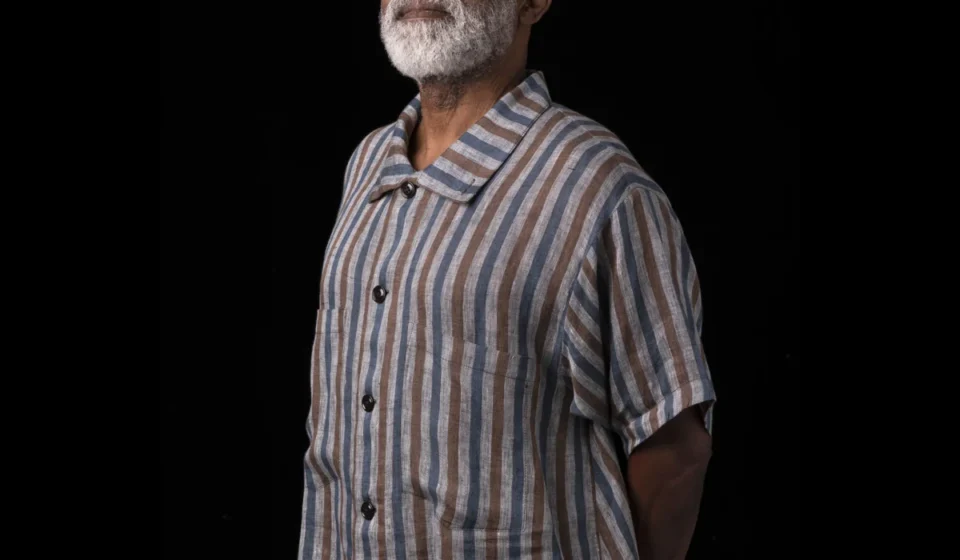

For decades, Seitu K. Jones has been a cornerstone of the Twin Cities’ cultural landscape. As an artist, activist, and educator, his work has consistently sought to bridge the gap between community survival and artistic expression. Yet, in a striking irony that underscores the systemic invisibility often faced by artists of color, the Minnesota Museum of American Art (the “M”) is currently hosting the first-ever solo museum exhibition of his long and illustrious career.
Titled “The Smell of Earth: Seitu K. Jones Working in the Elements,” the exhibition, which runs from October 22 through July 25, 2027, serves as both a retrospective of Jones’s technical prowess and a meditation on the cyclical nature of Black history, agriculture, and identity in America. Through charcoal, oil, sculpture, and archival retrieval, the exhibition establishes Jones not merely as a regional figure, but as a vital chronicler of the African American experience.
The Connecting Cord: The Collard Green as Cultural Conduit
Walking through the galleries of the M, visitors are struck by the recurring motif of the collard green. It appears in meticulous charcoal renderings, vibrant paintings, and even within a hand-carved box crafted from Minnesota basswood. To Jones, this hearty green is far more than a culinary staple; it is a botanical anchor.
“I keep coming back to collard greens as a way of accessing Southern cuisine,” Jones explains. “And then exploring these African American culinary traditions—this line that connects us all to Africa.”
The decision to center the exhibition around this humble plant allows Jones to explore his complex relationship with the soil, cultural heritage, and the broader history of Black survival. By elevating the collard green to the status of fine art, Jones invites the viewer to look closer at the intersections of labor, geography, and memory. The exhibition showcases a surprising range of his technical ability, moving away from his well-known, large-scale public art projects toward a more intimate, observational scale that has long been hidden in his personal archives.
A Legacy Rooted in Agriculture and Resilience
To understand the depth of Jones’s work, one must look at his lineage. A fourth-generation Minnesotan, Jones’s roots are deeply intertwined with the shifting sands of American history. His great-grandfather, after liberating himself from enslavement, fought for the Union Army during the Civil War. He eventually settled in Red Wing, Minnesota, working as a porter for the St. James Hotel—a job that provided the capital necessary to purchase land and establish a farm in Rochester.
This agricultural legacy continued with Jones’s grandmother, who relocated to the Old Rondo neighborhood in St. Paul over a century ago. In an era when the shadow of slavery was still fresh, she transformed her urban backyard into a working farm.

“I can clearly still remember the plum trees that were there,” Jones recalls, noting the poignancy of a woman whose father had been forced to labor in fields choosing, by her own agency, to cultivate the land. These memories—of his grandmother’s garden and the lively, argumentative atmosphere of her kitchen on Fuller Avenue—form the emotional bedrock of his artistic practice.
Jones’s formal education reflects this dual commitment to art and the earth. He holds an undergraduate degree in landscape design from the University of Minnesota’s School of Agriculture and a graduate degree in environmental history. His advocacy work, most notably as a co-founder of Frogtown Farms, demonstrates that for Jones, art is not a detached activity, but a form of public service—a way to nourish both the body and the spirit.
The Imperative of Archival Preservation
Despite his national acclaim—including the ArtPrize Grand Juried Prize and the Joyce Award—Jones has spent much of his career grappling with the precarity of Black artistic legacy. His frustration with the art world’s failure to maintain the work of Black and Indigenous creators is palpable.
“I’ve lost so many friends, collaborators, mentors, people who I looked up to, who passed on and whose work has literally ended up in a dumpster, or whose legacies are not remembered,” Jones says. “Unfortunately, what happens more and more to African American artists and Indigenous artists and other artists of color is that after a generation, their memories are gone.”
In response, Jones established The Black Gate, an archival initiative dedicated to preserving the oeuvres of Black artists. “The Smell of Earth” itself is a product of this archival rigor. Working with curators Ego Ahaiwe Sowinski and Alexandra Nicome, the team unearthed works from rolled-up tubes that had been stored away for years.
Nicome notes that the process was revelatory. “We were interested in showing these works where Seitu had an opportunity to slow down and really work at a more intimate scale,” she says. The exhibition includes detailed studies of germinating collards and older, repaired pieces like “Sabian” (1997), a poignant painting of his cousin’s son ice fishing. By placing his own work in conversation with mentors and heroes like George Morrison, Jones is not only claiming his place in the canon but ensuring that the lineage of Black Minnesota art remains visible.
The Body as a Site of History
A central component of the exhibition is Jones’s series of self-portraits. In these works, Jones acts as a stand-in for the collective Black experience over the last 400 years. These are not merely studies of the self, but historical re-enactments of the joys, the labor, and the violence inherent in the American project.

In the museum’s atrium, large-scale charcoal drawings depict figures floating in states of transcendence—a nod to his public art practice and his belief in the resilience of the human spirit. However, the exhibition does not shy away from the darker realities of the Black experience.
In “Street Scene (Self portrait),” Jones depicts himself lying in the street with his eyes closed, accompanied by a pair of abandoned boots. The piece serves as a stark commentary on the twin specters of urban violence and systemic police brutality. In another work, the visual of dangling feet contrasted against a beautiful landscape forces a confrontation with the history of lynching—a jarring juxtaposition that links the beauty of the natural world to the scars left by human hatred.
Implications for the Future of Representation
The significance of “The Smell of Earth” extends beyond the aesthetic. By providing a platform for Jones’s lifelong body of work, the Minnesota Museum of American Art is addressing a long-standing oversight in institutional curatorship. The exhibition acts as a necessary corrective, proving that an artist who has spent his life working in the streets and in community gardens is just as deserving of the white-cube space as any traditional painter or sculptor.
The show offers an “emotional punch,” as critics have noted, but it is also a quiet, soulful homage to the land. Jones’s career—from the streets of St. Paul to the halls of the museum—is a testament to the idea that art is a living, breathing thing. It requires cultivation, protection, and, perhaps most importantly, a deep, abiding respect for the earth and the ancestors who worked it before us.
As the exhibition continues its run through the summer of 2027, it stands as a mandatory visit for anyone interested in the intersection of environmental justice, Black history, and contemporary art. It is a reminder that while the memory of artists may fade if left to the whims of the market, the work itself—when properly preserved and presented—retains the power to transform the way we see our world.
Exhibition Details
- The Smell of Earth: Seitu K. Jones Working in the Elements
- Dates: October 22, 2026 – July 25, 2027
- Location: Minnesota Museum of American Art, 350 Robert St N, St. Paul, MN
- Admission: Free
- More Information: mmaa.org/the-smell-of-earth-the-work-of-seitu-k-jones/