





















































A System in Flux: Minnesota State Approves Controversial Funding Shift to Bail Out Struggling Universities

In a move that underscores the deepening fiscal instability within Minnesota’s public higher education landscape, the Minnesota State Board of Trustees voted on Wednesday to authorize a major reallocation of resources. Under the approved plan, the system will transfer up to $25 million annually over the next four years to institutions currently teetering on the brink of financial collapse.
The strategy, while framed as a necessary "bridge" to prevent total operational failure at specific sites, has sparked a firestorm of debate. The funds are to be pulled from the budgets of the system’s 26 colleges and seven universities—a move that effectively forces healthy or stable institutions to subsidize the deficits of those facing severe crises.
The Core Mandate: Rescuing St. Cloud and Bemidji
The primary beneficiaries of this emergency infusion are St. Cloud State University and Bemidji State University. For the 2028 fiscal year alone, St. Cloud State is slated to receive $10 million, while Bemidji State will receive $4.8 million.
System officials argue that this intervention is a short-term, emergency measure. Both universities have already undergone painful restructuring, including massive layoffs, the suspension of hundreds of academic programs, and the exhaustion of long-standing reserve funds. Despite these drastic measures, the two institutions remain unable to balance their books, necessitating this inter-institutional lifeline.
A Chronology of Financial Erosion
To understand how the system arrived at this point, one must look at the slow-moving collision of demographics and economics.
- 2011–2016: The early stages of the crisis were marked by steady declines in enrollment across rural and mid-sized Minnesota campuses, largely driven by a shrinking population of traditional college-aged students.
- 2023: St. Cloud State began an aggressive, and ultimately insufficient, effort to curb costs, suspending admissions to nearly 200 academic majors, minors, and certificate programs.
- 2026 (September): System officials unveiled the "emergency transfer" proposal. Initial drafts were met with fierce resistance from community college presidents, leading to revisions that protected institutions with the lowest cash reserves.
- 2026 (October): The Board of Trustees officially approved the four-year funding shift. The plan requires the recipient universities to submit rigorous, transparent financial recovery plans as a condition of receiving the funds.
- 2028 and Beyond: The system faces a projected $100 million budget shortfall by the summer of 2028, necessitating a potential long-term pivot toward consolidation and campus closures.
Supporting Data: The Anatomy of a Deficit
The financial health of the Minnesota State system has been eroding for over a decade. St. Cloud State, once a flagship of the system, has seen its workforce reduced by 40% over the last 15 years. Its reserve funding pool, which held nearly $19 million a decade ago, is expected to be entirely depleted by the summer of 2027.
Across the broader system, the financial burden is distributed unevenly. Under the new mandate, Minnesota State University-Mankato will bear the largest individual burden, contributing $1.8 million in the first year alone. Across the system, contributions range from $121,000 to over $1.7 million.
The two-year institutions, represented by leaders like Michael Berndt—who serves as president of both Dakota County Technical College and Inver Hills Community College—are particularly vulnerable. Together, his institutions enroll approximately 6,600 students and will be forced to contribute $747,533 to the emergency fund. This comes on the heels of years of frozen budgets, deferred maintenance, and increasing class sizes, which have already left these colleges operating on thin margins.
The Human Cost: Perspectives from Leadership
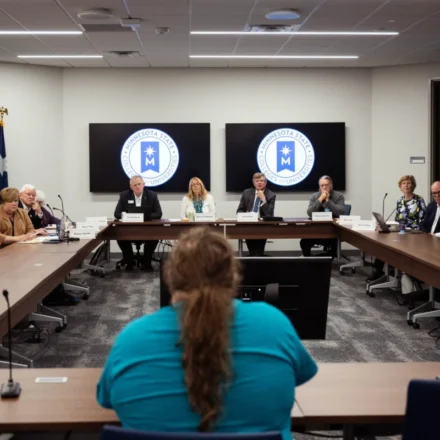
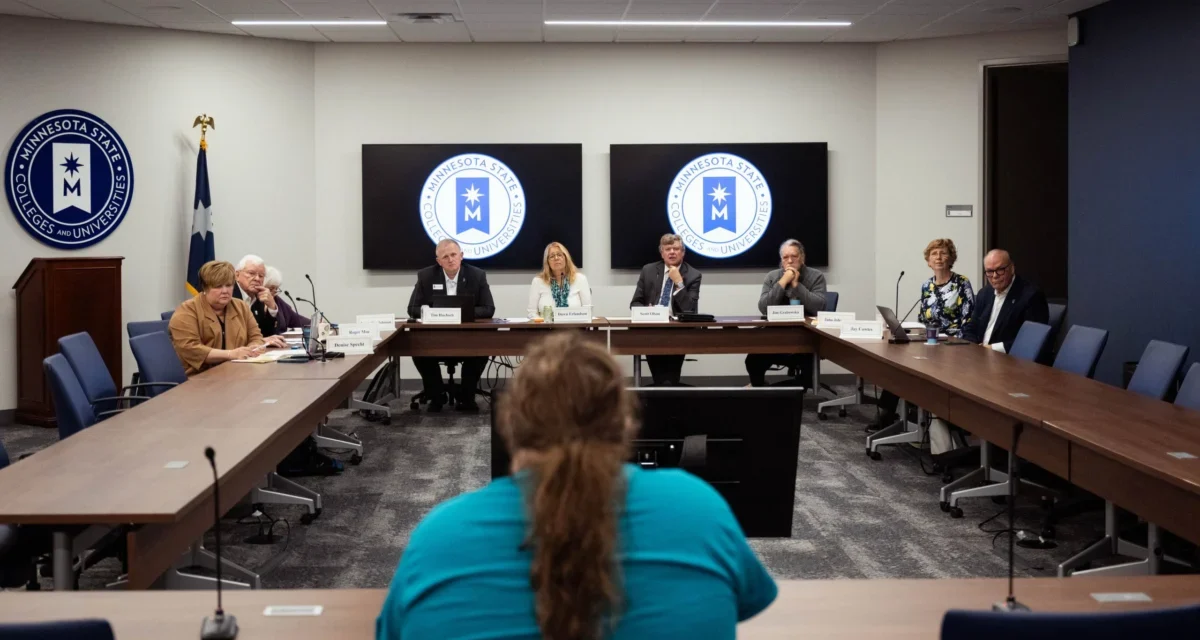
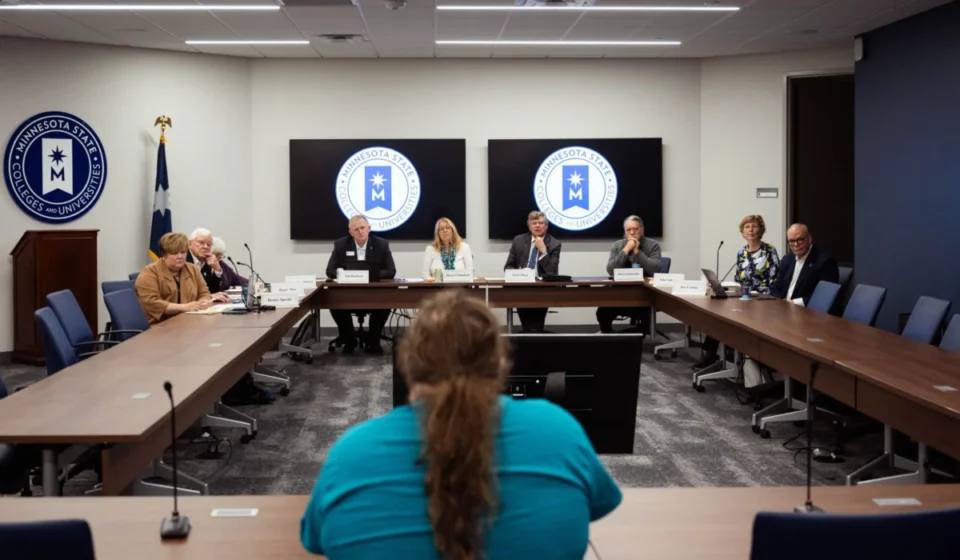
The atmosphere at the board meeting was somber, reflecting the gravity of the decision. For many, the vote represented a choice between two equally undesirable outcomes.

Michael Berndt, representing the collective voice of the two-year college presidents, did not mince words regarding the morale of his staff. "It’s frankly demoralizing to our employees to see the outcome of our work significantly reduced by seeing our allocation dollars reduced," Berndt told the trustees. While he conceded that the latest version of the proposal was "stronger and more thoughtful" than initial drafts, he noted that he still faces the difficult task of justifying these losses to his students and local lawmakers.
Conversely, Edward Inch, president of Minnesota State University-Mankato, emphasized the collective responsibility of the system. "It’s not a choice that gets made between a good idea or a bad idea," Inch stated. "It’s competing choices of things that are damaging or less damaging." According to Inch, the system is "spread very thin," and there is a "price to be paid for the whole system" to ensure that the universities do not collapse entirely.
Trustee Roger Moe, in a moment of candid pragmatism, characterized the vote as a bitter necessity: "We take the tough medicine, and hopefully we can get this thing corrected over the years coming ahead."
Implications: The Future of Minnesota Higher Education
The decision to reallocate funds is only one piece of a much larger, more radical transformation planned for the Minnesota State system. With a $100 million shortfall looming, the administration is preparing to bring a series of difficult proposals to the State Legislature.
1. Legislative Advocacy
System officials are preparing to request $65 million in one-time support from the state. This includes the $25 million currently being shuffled between schools. Bill Maki, the system’s vice chancellor for facilities and finance, was clear about the limitations of the current plan: "It’s not the most ideal plan. The most ideal would be that the state would support this."
2. Infrastructure Consolidation
In addition to the cash transfer, the board approved a measure to divert $24.3 million from equipment budgets through 2032. This money will be used for the demolition of "unnecessary" campus buildings. Many of these structures, built during previous eras of expansion, have become financial liabilities due to high maintenance costs and energy inefficiencies. The system is essentially paying to destroy its own assets to save on long-term operating costs.
3. The Threat of Mergers
The "bridge" funding is intended to buy time for a more permanent solution. That solution will likely involve the consolidation of campuses and the centralization of administrative services—including IT, cybersecurity, and financial management—across the state. The prospect of closing campuses remains a political lightning rod, but officials increasingly suggest it may be inevitable if the current enrollment decline is not reversed.
Conclusion: A System at a Crossroads
The move by the Minnesota State Board of Trustees is a stark reflection of the realities facing regional public university systems across the United States. Declining enrollment, exacerbated by inflation and a lack of sustained legislative funding, has forced these institutions into a zero-sum game.
By choosing to cannibalize the budgets of smaller, potentially more stable two-year colleges to keep larger, struggling universities afloat, the system has prioritized institutional survival over institutional growth. The coming years will reveal whether this "tough medicine" acts as a cure or merely delays the inevitable. For now, students and faculty across Minnesota are left to navigate the consequences of a system forced to contract, consolidate, and fight for its very existence.