















































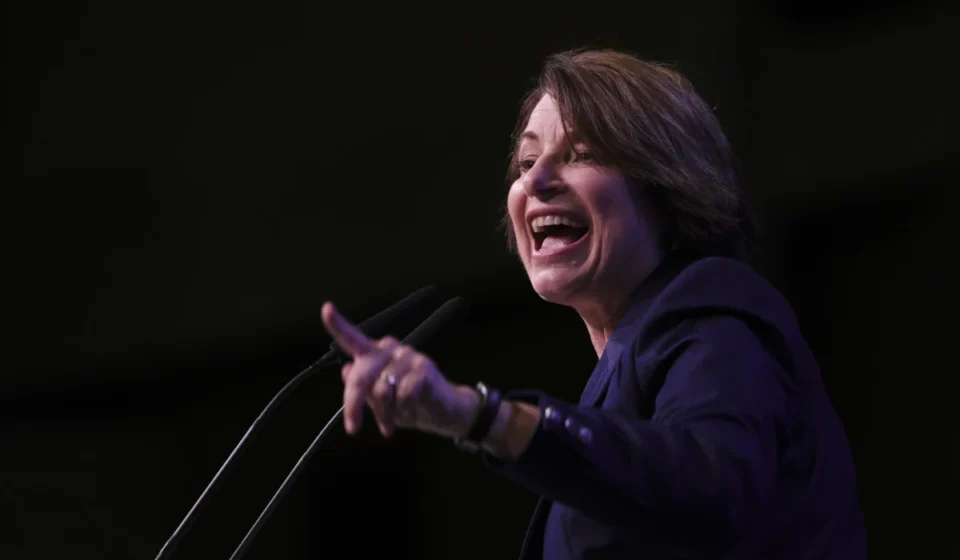
Senator Amy Klobuchar Forges New Path, Pivoting from Washington Clout to Minnesota’s Top Executive Seat

WASHINGTON D.C. / ST. PAUL, MN – In a move that sent ripples through both national and state political circles, U.S. Senator Amy Klobuchar, a formidable figure in the Democratic Party’s leadership, has announced her candidacy for Governor of Minnesota. Her decision, coming in the wake of incumbent Governor Tim Walz’s unexpected withdrawal from a potential third term, marks a seismic shift in the state’s political landscape, signaling Klobuchar’s profound commitment to Minnesota and her impatience with the perceived gridlock of Washington.
"I truly do love my job in the Senate, but I love my state more than any job and I believe that we can get to a better place," Klobuchar declared, her voice resonating with a familiar blend of earnestness and determination. "I don’t like the status quo."
Her declaration sets the stage for what is widely expected to be a dominant campaign, positioning her as the heavy favorite to become Minnesota’s next chief executive and, significantly, its first woman governor. Klobuchar’s strategy is clear: distance herself from the outgoing administration, tackle allegations of fraud head-on with a comprehensive 40-point plan for government reform, and initiate rapid transformation. "Patience is a virtue, but it’s one I don’t have," she asserted, underscoring her readiness for immediate action.
The Call to Govern: A Timely Transition
The decision by Governor Tim Walz in early January to reverse course and not seek a third term created an immediate vacuum and a scramble within the Democratic-Farmer-Labor (DFL) Party. Walz’s announcement, delivered with just a day’s notice, thrust the DFL into an unexpected search for a top-tier candidate capable of retaining the critical gubernatorial seat in the "blue" column.
It was in this moment of political flux that calls began pouring in for Klobuchar. Both state DFLers and national Democratic strategists recognized her unique standing and electability. Despite the significant seniority and influence she had accrued over nearly two decades in the Senate, Klobuchar acknowledged the intense pressure to consider a return to state politics. "I’d been saying, ‘Maybe you could wait two weeks,’" she recounted, referencing her own brief period of deliberation before formally filing as a gubernatorial candidate.
The allure of remaining in the Senate was strong. As a member of Democratic leadership, Klobuchar had steadily climbed the ranks, securing the No. 3 spot as chair of the Steering and Policy Committee. This position afforded her considerable sway over legislative priorities and appointments, making her departure a genuine loss for the federal Democratic caucus. "There were a lot of people in the Senate that made the case for me to stay there," she admitted, reflecting on the pleas from her Capitol Hill colleagues.
However, Klobuchar ultimately concluded that Minnesota’s immediate needs outweighed her personal and political investment in Washington. "But I think people understood the unique moment we were in as a state and why I made that decision," she explained, hinting at a confluence of factors that made the gubernatorial race an undeniable imperative. This "unique moment" appears to be defined by a growing frustration with state-level challenges and a profound desire to enact direct, tangible change that Klobuchar felt was increasingly difficult to achieve in the often-stalemated halls of Congress.
Strategy for the Capitol: Distancing and Reforming
Klobuchar’s early campaign messaging has been carefully crafted. While a loyal Democrat, her stated intention to "distance herself from Gov. Tim Walz" suggests an understanding that voters may be ready for a fresh approach, even from within the same party. This strategy allows her to acknowledge past administrations while simultaneously presenting herself as an agent of new ideas and decisive action. Her proposed "40-point plan aimed at reforming state government" is central to this narrative, promising a comprehensive overhaul designed to restore public trust and enhance efficiency. While specific details of the plan are still emerging, its breadth suggests a focus on transparency, accountability, and a streamlined bureaucracy.
A critical, and deeply personal, motivator for Klobuchar’s gubernatorial bid stems from what she described as the "horror" of recent events in Minnesota. She specifically cited the murders of former Minnesota House Speaker Melissa Hortman and her husband, the mass shooting at Annunciation Catholic School, and the deaths of Renee Good and Alex Pretti during the federal "Operation Metro Surge." These tragic incidents, she indicated, underscored a profound sense of urgency and a belief that state-level executive leadership could play a more direct role in addressing systemic issues contributing to violence and instability.
"I’ve always believed that we could get to higher ground and it’s been one thing after another that’s made that hard in Minnesota," she lamented, suggesting that these public safety crises reinforced her conviction that the state needed a leader prepared to confront difficult challenges head-on. Her focus on cracking down on fraud, reforming government, and addressing public safety concerns aligns with a pragmatic, results-oriented approach that has defined her career.
Further solidifying her team, Klobuchar recently tapped former Fergus Falls Mayor Ben Schierer as her lieutenant governor candidate. Schierer, a figure with local executive experience, is expected to complement Klobuchar’s statewide and national profile, bringing a grassroots perspective and administrative acumen to the ticket.
A Political Juggernaut: Klobuchar’s Electoral Strength
Having represented Minnesota in the U.S. Senate since 2007, Amy Klobuchar is not just a known political commodity; she is a political institution within the state. Her career trajectory, from Hennepin County Attorney to U.S. Senator and even a bid for the White House, has afforded her decades of name recognition and a formidable political machine.
Early in her career, some of her recognition stemmed from her father, Jim Klobuchar, a beloved and prominent sports and politics reporter for the Star Tribune. Today, however, Amy Klobuchar has far surpassed her father’s public profile, becoming the undisputed most recognizable Klobuchar in Minnesota. Her political gravitas is such that the DFL Party is openly banking on her name at the top of the ballot to generate a significant "coattail effect," boosting the prospects of other DFL candidates down-ticket.
Jacob Rubashkin of Inside Elections, a respected political analyst, affirmed Klobuchar’s electoral prowess. "Her strength is that she has universal name ID and a track record of being the strongest DFL statewide candidate over the past decade," Rubashkin stated. He further highlighted her robust campaign infrastructure, noting, "She has a nationwide fundraising base from her time in the Senate and presidential run, and an existing statewide infrastructure that she can redirect to her gubernatorial contest."
Indeed, Klobuchar’s fundraising efforts have been extraordinary, already surpassing $7 million in campaign cash. This war chest significantly outpaces her political rivals, granting her a distinct advantage in advertising, organizing, and outreach.
While Klobuchar is heavily favored to win the Democratic primary in August against progressive challenger Kobey Layne, the general election promises a contest against one of three prominent Republicans vying for their party’s nomination: House Speaker Lisa Demuth, former healthcare executive Kendall Qualls, or My Pillow CEO Mike Lindell.
Acknowledging the unknown Republican opponent, Klobuchar has strategically focused much of her general campaign rhetoric on national issues, particularly criticizing former President Donald Trump on a range of topics, including the "reflecting pool fiasco" – a veiled reference to a contentious event during Trump’s second inauguration. She also champions the broader Democratic mantra of "affordability," addressing public concerns over rising prices for oil, food, and other necessities.
Interestingly, her direct appeals for campaign donations often single out Mike Lindell. Lindell’s staunch allegiance to Trump and his propagation of false claims about the 2020 election have made him a polarizing, yet highly recognizable, figure. Klobuchar’s team likely views him as the most vulnerable general election opponent, given his legal entanglements and multi-million dollar judgments stemming from his election claims.
Regardless of who emerges from the GOP primary, the Republican candidate will face an uphill battle. Minnesota has not elected a Republican to a statewide office in 20 years, a testament to the DFL’s entrenched strength and Klobuchar’s proven ability to win over broad swaths of the electorate.
The Weight of Washington: Senate Frustration and Gubernatorial Power
Klobuchar’s decision to leave the Senate for a state executive role is not unique among federal lawmakers, and political observers suggest a common underlying motivation: the frustration of legislative gridlock. Tim Lindberg, a political science professor at the University of Minnesota Morris, articulated this perspective, suggesting Klobuchar may have grown weary of the closely divided Senate.
"Whether the chamber is controlled by Democrats or Republicans, the filibuster rule that requires much legislation to have the support of at least 60 senators has impeded many initiatives from moving forward," Lindberg explained. This procedural hurdle effectively necessitates bipartisan consensus for most major legislation, a challenging feat in an increasingly polarized Congress. "Being governor allows her to be in a power position where she can do things and make big changes," Lindberg concluded, highlighting the direct executive authority available to a governor compared to a senator who is one of a hundred.
This sentiment was echoed by Senator John Hoeven, R-N.D., a colleague who has worked closely with Klobuchar on regional issues. Hoeven, himself a former North Dakota governor, suggested Klobuchar might have been evaluating her career trajectory within the Senate. "She had to weigh, ‘Do I stay and see how that plays out or do I go back to Minnesota?’" Hoeven remarked. His own experience offers a compelling comparison: "Governor was the better job," Hoeven asserted. "I am deeply honored to be in the Senate, but as governor you can set your agenda and work with people to achieve it and Amy would really like that." This candid assessment underscores the appeal of executive power and the ability to directly implement a vision, a stark contrast to the often incremental and compromise-laden work of a legislator.
Klobuchar’s tenure in the Senate has been defined by a pragmatic, bipartisan approach. She is widely considered a moderate, yet one unafraid to challenge powerful interests, including the pharmaceutical industry and tech giants. Her reputation as a workaholic, a trait she admits can wear out her staff, is coupled with a remarkable ability to forge common ground with Republicans. "I’ve always focused on getting things done," she emphasized. "There’s this moment in time that is not going to be like any other where we’ve been facing hard things and I want to make sure that we stay together as a state, despite the political divides and changing the status quo and not just accepting things and restoring people’s trust in our government again."
Her bipartisan credentials are not merely rhetorical. Senator Tammy Baldwin, D-Wis., lauded Klobuchar’s persuasive skills and instinct for compromise. "When she’s trying to persuade a colleague on an issue, she’s really prepared," Baldwin noted. "She also has the instinct to know where an agreement can be forged."
A notable example of her cross-aisle collaboration is the "Take It Down Act," co-sponsored with Senator Ted Cruz, R-Texas. This landmark legislation criminalizes the non-consensual sharing of AI-generated images and mandates social media platforms to remove such content within 48 hours. Klobuchar even leveraged her position as chairman of the Joint Congressional Committee on Inauguration Ceremonies, interacting with First Lady Melania Trump during President Donald Trump’s second oath of office, to successfully lobby for the president’s support of the bill. "It’s a model (to take down) other inappropriate things on platforms," Klobuchar observed, highlighting its potential broader impact. Lindberg characterized her bipartisanship as "politically palatable," suggesting she finds common ground where interests align, rather than embracing opposing ideologies wholesale.
The Cost of Departure: Minnesota’s Federal Clout at Stake
While Klobuchar’s departure is poised to significantly benefit the DFL’s statewide ticket and potentially energize the gubernatorial race, it simultaneously raises questions about the future of Minnesota’s federal clout. If she wins in November, her absence from the Senate will create a void that will be difficult for any appointed successor to fill immediately.
Klobuchar’s seniority and legislative acumen have been instrumental in directing billions of federal dollars and crucial projects to Minnesota. Senator Baldwin recalled working with Klobuchar to secure over $1 billion for the replacement of the 60-year-old Blatnik Bridge, a vital interstate crossing connecting Duluth, Minnesota, and Superior, Wisconsin. Though the project received initial approval through former President Joe Biden’s massive infrastructure bill, concerns arose about its fate following President Trump’s second election. The Democratic senators successfully lobbied Transportation Secretary Sean Duffy, a northern Wisconsin native, to ensure the project’s continuity.
Similarly, Klobuchar’s collaborative efforts with Senator Hoeven secured significant federal funding for a U.S. Army Corps of Engineers flood prevention project along the Red River, a shared waterway between Minnesota and North Dakota. This $3.2 billion public-private partnership, as Hoeven described, required "a lot of legislation," a testament to Klobuchar’s skill in navigating complex legislative processes. These examples underscore the tangible benefits Minnesota has reaped from her seasoned presence in Washington.
An appointed senator, lacking Klobuchar’s seniority, committee assignments, and established relationships, would face a steep learning curve and diminished immediate influence. This potential loss of federal advocacy will be a significant challenge for the state, especially concerning future infrastructure funding, agricultural policies, and other federal initiatives crucial to Minnesota’s economic and social well-being.
Stakeholder Perspectives and Official Responses
Beyond the direct statements of Klobuchar and her Senate colleagues, the political ecosystem in Minnesota is already reacting to this momentous shift.
Senator Baldwin, reflecting on Klobuchar’s commitment to her constituents, remarked, "She visits every single county in Minnesota every year. That means to me she knows every corner of the state and she has her finger on the pulse." This grassroots dedication is seen as a key asset for her gubernatorial campaign, demonstrating a deep understanding of the diverse needs and concerns across Minnesota.
A DFL party strategist, speaking on background due to ongoing campaign considerations, stated, "Senator Klobuchar entering this race is a game-changer. Her unparalleled name recognition and proven ability to build broad coalitions give us an incredible advantage. We expect her to not only win decisively but also to lift the entire DFL ticket."
On the Republican side, while acknowledging Klobuchar’s formidable presence, party spokespeople maintain focus on their own primary. "Minnesota voters deserve a choice, and our robust field of Republican candidates offers distinct visions for the state’s future," commented a spokesperson for the Minnesota GOP. "We are confident that once our primary is decided, our nominee will articulate a compelling case for change and fiscal responsibility that will resonate with voters tired of the DFL’s policies." This indicates an awareness of the challenge Klobuchar poses, but also a commitment to campaigning vigorously.
Broader Implications: A New Era for the North Star State
Amy Klobuchar’s decision to leave the U.S. Senate and run for governor marks a definitive end to one chapter of her illustrious career and the beginning of another, potentially even more impactful one. For Minnesota, this represents a significant political realignment. The DFL Party gains an undeniably strong, seasoned candidate at the top of its ticket, bolstering its prospects not only for the governorship but also for down-ballot races.
If elected, Klobuchar’s governorship promises a shift towards a more direct, executive-driven approach to state governance. Her declared impatience with the status quo and her 40-point reform plan suggest an administration focused on efficiency, accountability, and proactive problem-solving, particularly in areas like public safety and government integrity. Her bipartisan track record from Washington could also translate into a collaborative approach in St. Paul, potentially fostering cross-party consensus on key state issues.
Nationally, Klobuchar’s move could be interpreted as a broader reflection of growing frustrations among federal lawmakers. The allure of executive power at the state level, where direct action and tangible results may feel more attainable than in a deeply divided Congress, could inspire other experienced politicians to consider similar transitions.
Ultimately, Klobuchar’s journey from a powerful national legislator to a gubernatorial hopeful is a testament to her enduring commitment to her home state. The coming months will determine whether Minnesota voters are ready to entrust their future to a leader renowned for her work ethic, pragmatism, and a distinct lack of patience when it comes to delivering change. Her path forward will undoubtedly reshape the political landscape of the North Star State for years to come.