










































Bridging Generations: The Collaborative Spirit of "Sakowin Synergy" at All My Relations Gallery

The contemporary art landscape in the Twin Cities is currently defined by a profound dialogue between legacy and innovation. At the heart of this cultural conversation is the All My Relations Gallery in Minneapolis, which is currently hosting "Sakowin Synergy," a landmark exhibition by South Dakota-based artist Ray “Rock Boy” Janis. The exhibition serves as more than a mere showcase of individual talent; it is a collaborative manifesto that bridges the gap between established mentors and an emerging generation of Indigenous artists.
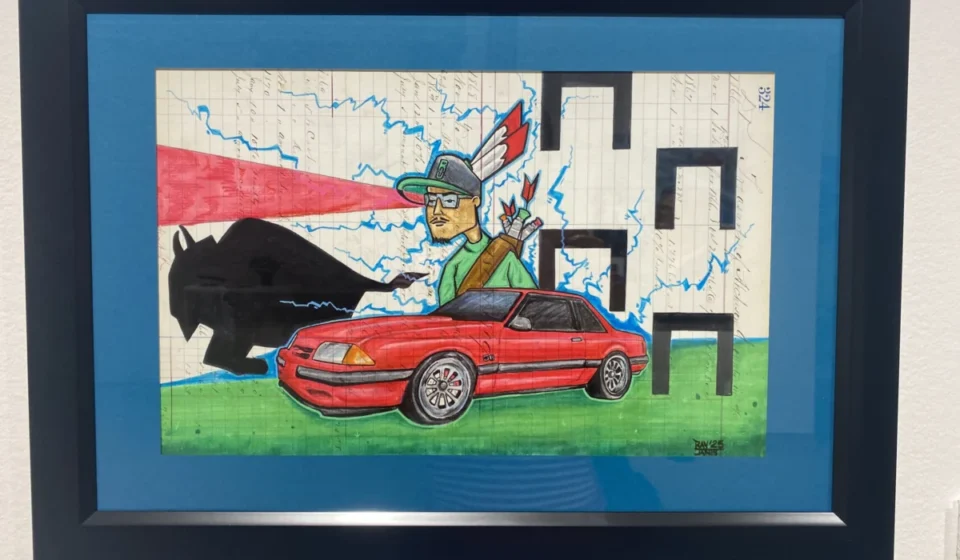
The title of the exhibition, "Sakowin Synergy," draws its inspiration from the Oceti Sakowin—the Seven Council Fires—a historic and enduring alliance of the Dakota, Lakota, and Nakota nations. By centering this theme, Janis invites viewers to contemplate cultural identity through a lens that is both deeply rooted in historical tradition and boldly forward-looking, utilizing motifs that span from traditional ledger art to modern superhero aesthetics.
Main Facts: A Convergence of Artistic Voices
The exhibition features the work of Ray Janis, but he is far from working in isolation. "Sakowin Synergy" serves as a collaborative platform, placing Janis’s work in direct conversation with his close friend, Sheldon Starr, and two pillars of the Native art community: Dwayne “Chuck” Wilcox and Jim Yellowhawk.
The composition of the artists reflects a multi-generational exchange. Wilcox and Yellowhawk provide a foundational "old-school" perspective, deeply informed by their respective backgrounds—Yellowhawk from the Itazipco Band of the Cheyenne River Sioux Tribe, and Wilcox, Starr, and Janis from the Oglala Lakota Nation. The resulting works in the gallery are not merely shared space; they are truly co-authored pieces that defy individual categorization.
One of the most striking examples of this collaboration is the 2026 work "Rez Boys Boogie." Painted on historical bookkeeping ledgers—a medium that evolved as a creative adaptation for Native artists in the 19th century when traditional materials were suppressed or scarce—the piece is a long, rectangular canvas depicting a pow wow circle viewed from a bird’s-eye perspective.
The labor behind "Rez Boys Boogie" is a testament to the exhibition’s title. Janis painted the central circle and the celestial sky elements; Starr contributed intricate, dynamic geometric forms and bat imagery; and Wilcox and Yellowhawk, both accomplished dancers, rendered themselves as dancing figures on the periphery. The result is a unified composition that feels both spiritual and kinetic, as if the figures are actively preparing to enter the sacred circle.

Chronology: From Mentorship to Masterpiece
The trajectory leading to "Sakowin Synergy" is one of gradual cultivation and professional growth. The relationship between the gallery and these artists is not new. Director Angela Two Stars notes that the gallery’s involvement with Janis and Starr dates back to 2020, when the pair participated in an emerging artist cohort organized in partnership with the Hennepin Theatre Trust.
Following that successful introduction, All My Relations featured the two artists in a group show in 2022. However, the current exhibition marks a significant evolution in their trajectory. The genesis of this specific collaborative effort can be traced back to a single moment of mutual artistic admiration. When Jim Yellowhawk, a long-time hero to Janis, witnessed a painting in which Janis had incorporated a character from "The Fantastic Four," he was struck by the ingenuity. Yellowhawk took the initiative to invite the younger artist to collaborate on his own canvas.
“I was like, ‘For real?’” Janis recalls of the initial invitation. “It’s one of my heroes growing up in the art world.”
The exhibition was originally slated to open in January 2026, but the schedule faced a necessary pivot. During the early months of the year, the All My Relations Gallery shifted its focus to become a critical hub for mutual aid in response to "Operation Metro Surge." The staff and artists chose to prioritize community survival over the exhibition calendar. Following this period of civic engagement, the gallery successfully launched the show on July 9, and it will remain open to the public through September 5.
Supporting Data: The Evolution of Ledger Art
The significance of the medium used in "Sakowin Synergy" cannot be overstated. Ledger art, historically defined by drawings on the pages of discarded financial ledgers, was a way for Plains Indian artists to document their history, battles, and cultural traditions during a time of intense displacement.
In "Sakowin Synergy," Janis and his collaborators treat this medium as a living language. They are not merely mimicking the past; they are evolving it. By blending digital-era sensibilities with the tactile history of the ledger, the artists create a bridge between the 19th-century struggle for preservation and the 21st-century search for identity.

The inclusion of works like "Tatanka O’sni" further highlights this evolution. In this painting, Janis depicts a bison rendered in icy, ethereal shades of blue, charging through diagonal lines that suggest both the shattering of ice and the manifestation of a spirit force. It is a piece that feels distinctly contemporary yet is grounded in the traditional iconography of the plains.
Official Responses and Perspectives
Angela Two Stars, the director of All My Relations, views the exhibition as a critical educational tool for the public and a vital experience for the art community.
“Wilcox and Yellowhawk have been like mentors to the younger artist generation,” Two Stars explained during the opening. “They have the old-school style, whereas Janis and Starr are more contemporary and digital. So the show is kind of blending those together, and using their work to speak to the influences of each other.”
The "blending" is perhaps most evident in the fact that, prior to this show, many of these artists—even those who have known each other for years—had never physically worked on the same piece of paper. The exhibition represents a rare moment where these distinct artistic voices have synchronized, creating a dialogue that spans decades of experience.
Implications: The Future of Indigenous Expression
The impact of "Sakowin Synergy" extends beyond the walls of the gallery. It serves as a reminder that the Twin Cities is a burgeoning epicenter for Indigenous art. As the summer transitions into autumn, the exhibition contributes to a broader, robust season of Native-led artistic programming.
The exhibition’s success in the face of previous community challenges—specifically the move toward mutual aid earlier this year—demonstrates the resilience of the local art scene. It highlights a shift where galleries are not merely sites for aesthetic consumption, but community spaces that reflect the political and social realities of the people they represent.

Visitors to the gallery are treated to a holistic experience. During the opening, guests were served fry bread and refreshments from the adjacent Pow Wow Grounds, reinforcing the sense of community that the exhibition seeks to celebrate. Seeing Ray Janis in the gallery, surrounded by his family and his mentors, provided a humanizing element to the work on the walls.
For those looking to engage further with the current landscape of Indigenous art in the Twin Cities, "Sakowin Synergy" is part of a larger, vibrant ecosystem. Other exhibitions currently or recently on view—such as "Encounters" at Bockley Gallery, "Queering Indigeneity" at the Minnesota Museum of American Art, and "Merciless: Indigenous Lands Since 1776" at the Weisman Art Museum—collectively demonstrate a powerful movement in contemporary art.
"Sakowin Synergy" stands out, however, for its focus on the power of the lineage. By actively involving the masters of the previous generation with the visionaries of the current one, the exhibition ensures that the "Seven Council Fires" continue to burn bright, fueled by the collaborative energy of artists who refuse to be defined by history alone, but rather by their capacity to rewrite it together. The show is not just an exhibition; it is an invitation to witness the future of the Oceti Sakowin, one brushstroke at a time.