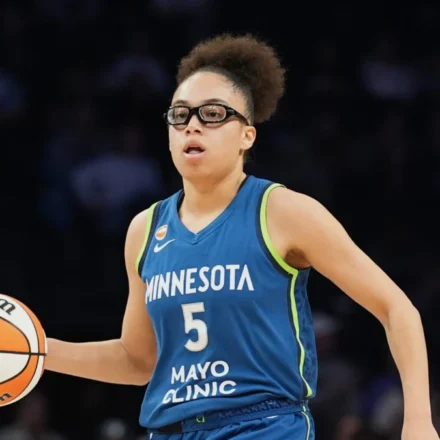
























































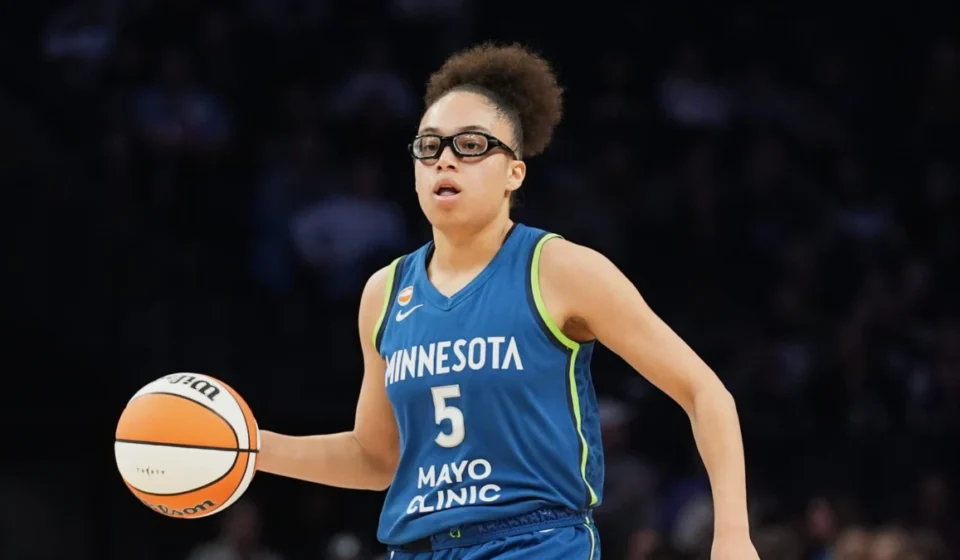

Seven games into her professional career, Olivia Miles walked into the Minnesota Lynx press conference room at the Target Center with the relaxed, unbothered air of a veteran—or perhaps a teenager strolling into her own living room. Clad in her game shorts and a black tank top, she suddenly paused, shivering. “It’s cold in here!” she remarked, a candid observation that drew chuckles from the assembled media. It was a moment that perfectly encapsulated the 22-year-old’s transition to the WNBA: unfazed, authentic, and hyper-aware of her surroundings.
Moments later, she sat on the riser next to veteran forward Natasha Howard, playfully fiddling with her teammate’s ear like a younger sibling teasing an older one. When Howard jokingly asked, “What’s wrong with you?” the answer was simple: nothing. In fact, everything about the rookie point guard’s integration into the Minnesota Lynx is going exactly right.
The Architect of an Early-Season Surge
While Miles’ personality has endeared her to the locker room, it is her on-court wizardry that has the rest of the league on notice. Five nights after her casual press room appearance, Miles delivered a masterclass in Phoenix, sparking the Lynx to a 111-77 blowout victory. She was lethal from the opening tip, recording 11 points in the first quarter alone on 4-for-4 shooting.
By the final buzzer, Miles had posted 19 points, 10 assists, four rebounds, and three steals. According to team statistics, she became the only WNBA rookie other than Caitlin Clark to record a 19+ point, 4+ rebound, and 3+ steal performance this season. Yet, those figures feel like a mere footnote to the eye test. Miles plays with a rhythm and vision that forces teammates and opponents alike to pause. Head coach Cheryl Reeve noted that several of Miles’ passes were so audacious that they elicited audible gasps from the coaching staff on the bench.
One such highlight—a needle-threading bounce pass in the third quarter that found newcomer Teaira McCowan for an easy layup—exemplified her ability to manipulate defensive coverage. Lindsay Whalen, the Naismith Basketball Hall of Famer and former Lynx legend, did not mince words when assessing the rookie. “I think she’s a better passer than I was,” Whalen said, “especially in the windows she’s able to find.”
A Chronology of Rapid Ascension
The trajectory of Miles’ rookie campaign has been nothing short of meteoric. On Opening Night, teammate Courtney Williams dubbed her "a little baby Chelsea Gray" after Miles dropped 21 points and eight assists in her professional debut.
The consistency followed. Miles scored in double figures in each of her first 10 games, eclipsing the franchise rookie record previously held by legends Seimone Augustus and Tonya Edwards. Notably, even the legendary Maya Moore did not reach such immediate, sustained offensive output during her rookie year in 2011.
The momentum reached a fever pitch last Thursday against the Golden State Warriors, where Miles shattered the league record for three-pointers by a rookie in a single game, sinking eight from behind the arc. This performance was particularly striking given that she had made only two of her previous 18 attempts from deep. Entering the weekend, Miles leads all WNBA rookies in scoring (17.0 PPG), assists (6.4 APG), steals (1.5 SPG), and minutes played (30.4 MPG). Her performance throughout May earned her the WNBA Rookie of the Month honor, placing her firmly at the forefront of the Rookie of the Year conversation.
Supporting Data and Strategic Synergy
The success of the Lynx, who currently boast an 8-2 record and a league-leading 13.0 net rating, is a testament to the "Miles Effect." The team has achieved this dominance without the acquisition of high-profile free agents, relying instead on a cohesive unit anchored by Miles, Williams, Kayla McBride, and Howard.
The chemistry between Miles and Howard has become the team’s most reliable weapon. Howard, a 13-year veteran, has flourished in the pick-and-roll game under Miles’ direction. “It’s unbelievable,” Howard said. “She sees things before they happen. I’ve got to make sure my hands are ready at all times. I never know when she’s going to pass it.”
This connection is rare. Howard noted that in her long career, she has only established such immediate synergy with three other elite point guards: Sue Bird, Sabrina Ionescu, and Lindsay Whalen. For Miles, the synergy is organic. “She’s just cerebral,” Miles said of Howard. “You don’t really have to tell her where to screen or how to screen. It’s just kind of a natural energy.”
Official Perspectives: The Coach and The Critic
Coach Cheryl Reeve, known for her high standards and demanding defensive philosophy, has been remarkably lenient with her rookie’s flair. When asked about a failed, flashy pass between the legs of Jordin Canada against Atlanta, Reeve’s response was characteristically supportive.
“I want her to be herself, her confident, authentic self,” Reeve said. “If there’s something we don’t like, we’ll share it. But in general, I want her to go.”
Sandy Brondello, the coach of the Toronto expansion side, echoed this sentiment. Having coached numerous stars throughout her illustrious career, Brondello labeled Miles a “generational point guard.”
“We haven’t had many like her for a while,” Brondello observed. “Just her ability to pass the ball in the pick-and-roll, she’s great. She gets downhill. She can finish. But she’s also a great passer. She sees the whole floor. A great young talent to build around.”
Implications: A New Era in Minnesota
The emergence of Miles comes at a critical juncture for the Lynx. Following a chaotic offseason defined by the league’s new collective bargaining agreement and a flurry of roster departures—including key defensive pieces and the uncertainty surrounding superstar Napheesa Collier’s health—the future of the franchise appeared clouded.
Critics who questioned the front office’s decision to draft Miles instead of a traditional center like UCLA’s Lauren Betts have been silenced. In the modern WNBA, where pace and perimeter spacing dictate winning, the value of a savvy, high-IQ floor general cannot be overstated.
Miles, who earned two degrees at Notre Dame before completing a final season at TCU, arrived at camp admittedly nervous. She feared stepping on the toes of seasoned champions. “I didn’t want to come in and upset anyone,” Miles admitted. “But it was so easy. The culture, people just want to win.”
As the season progresses, the implications are clear: the Lynx have not merely filled a position; they have discovered a leader. With her East Coast confidence, her penchant for no-look passes, and a defensive tenacity that belies her age, Miles has transformed the Lynx from a team in transition into a legitimate title contender.
Reeve, who has seen it all in the WNBA, summed up the current state of affairs best while speaking to the press in Phoenix: “You can call her a rookie if you want to. She’s just always ready for the moment.”
For Minnesota, that moment is now. With Miles pulling the strings, the Lynx are proving that sometimes, the most effective way to navigate an uncertain future is to put the ball in the hands of the player who isn’t afraid to take the shot—or the pass—that no one else saw coming.