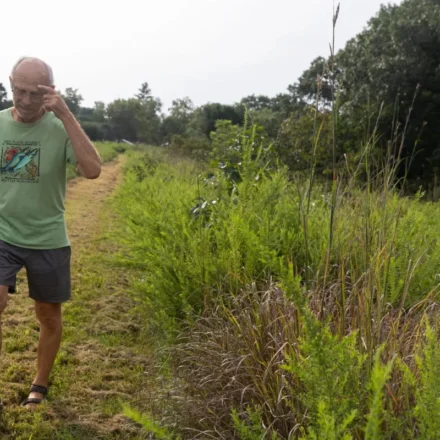
























































In a quiet, 28-acre grove in southern Vermont, a high-stakes experiment in survival is unfolding. Dressed in standard-issue field gear, Gus Goodwin, the Nature Conservancy’s director of science and technology advancement in Vermont, kneels before a young American elm. He carries a bamboo stake marked at 12 inches, a tool for precise calibration. With a steady hand, he drills a one-inch hole into the trunk, angling the bit downward. He then produces a blue pipette, injecting two teaspoons of a solution teeming with 100,000 spores of Ophiostoma novo-ulmi—the fungus responsible for the relentless scourge of Dutch elm disease (DED).
“We need to create a wound,” Goodwin says, his voice matter-of-fact as the drill whirs. “That’s it. Pretty simple.”
This ritual, repeated across 5,300 saplings in the research plot, is not an act of destruction for its own sake. It is a calculated, brutal trial by fire. By intentionally infecting these trees, scientists aim to identify the rare individuals possessing the genetic fortitude to survive a pathogen that has, for nearly a century, decimated one of North America’s most iconic species.
The Rise and Fall of the Cathedral Tree
The American elm (Ulmus americana) was once the architectural centerpiece of the American landscape. Known for its vase-like shape and sprawling, cathedral-like canopy, the tree was a fixture of rural meadows, urban boulevards, and sacred Indigenous council grounds.
In the 19th century, Henry David Thoreau famously noted that the elm was recognizable from further away than any other tree, beautiful in both sunlight and moonlight. Yet, by the mid-20th century, that beauty was under siege. DED, a fungal pathogen likely introduced to North America via imported timber in the 1920s, uses native elm bark beetles as vectors to travel from tree to tree. Once inside, the fungus triggers an immune response so aggressive that the tree effectively clogs its own vascular system—its xylem—with balloon-like structures called tyloses, leading to starvation and death.

The impact was swift and catastrophic. Millions of elms vanished. In New Haven, Connecticut—the “Elm City”—the landscape was stripped of its namesake. In Minneapolis, tens of thousands of trees were removed annually at the height of the epidemic. Today, 95 percent of the original American elm population is estimated to be gone.
A Chronology of Conflict
The effort to save the species has been a century-long saga marked by desperation, technical failures, and renewed hope.
- 1920s–1930s: Dutch elm disease is officially identified. Early attempts to curb the spread focused on mass removal. President Franklin D. Roosevelt allocated $2.5 million in 1935 to fell infected trees, but because officials did not realize the fungus could travel through underground root grafts, the culling often accelerated the contagion.
- 1940s: World War II diverts resources away from forest research. Simultaneously, a more aggressive strain of the fungus, Ophiostoma novo-ulmi, arrives in North America, turning an already dire situation into an ecological disaster.
- 1970s–1990s: Scientists like Alden “Denny” Townsend of the U.S. National Arboretum begin rigorous breeding programs. They succeed in identifying tolerant cultivars such as “Valley Forge” and “New Harmony,” which show promise but suffer from limited genetic diversity and structural quirks.
- 2000s–Present: A new generation of ecologists, including Christian Marks and Jim Slavicek, pivot toward a more holistic strategy. They collect samples from rare, mature “survivor” trees across New England—specimens that have lived for decades in the shadow of the disease—to crossbreed for higher levels of tolerance and genetic variety.
Supporting Data: The Rigor of Selection
The current project in Vermont is the most sophisticated iteration of this work to date. The goal is not merely to create a tree that survives once, but one that possesses the hardiness to survive repeated exposure over a 150-year lifespan.
According to research, only about one in 100,000 elms in the wild may hold the key to true tolerance. Unlike the American chestnut, where researchers are using gene editing to combat blight, the American elm lacks a clear genetic marker for resistance, making classical crossbreeding the only viable path.
The data collected at the Benson site is tracked via a specialized app. As crews inject the saplings, they record everything from genetic lineage to the presence of epicormic shoots—small sprouts that often signal tree stress. As of mid-2026, initial observations are encouraging: while hundreds of trees have succumbed to the intentional infection, roughly 800 remain symptom-free, standing as potential candidates for the next generation of “super trees.”

Official Responses and Scientific Perspective
The scientific community is tempering its optimism with caution. There is a broad consensus that we must avoid the mistakes of the past—specifically, the reliance on monocultures.
“One lesson we learned from Dutch elm disease is not to plant a monoculture of trees,” says arborist Doug Still. “Diversifying your tree population is a safeguard against future pests.”
The project has also faced scrutiny regarding its cost and the feasibility of large-scale restoration. Some critics question whether the effort is worth the millions of dollars invested. However, proponents argue that the American elm provides irreplaceable ecological services. Beyond their aesthetic value, elms are uniquely shade-tolerant and flood-tolerant, making them critical buffers against the increased flooding caused by climate change. In Vermont, which has faced multiple “100-year” floods in recent years, the restoration of healthy floodplains could save an estimated $1 billion in property damage over the next century.
“There’s no other floodplain tree that’s shade-tolerant, flood-tolerant, and long-lived,” notes Goodwin. “It’s a moral injury to let a species go extinct when we have the tools to repair it.”
Implications: The Future of the American Landscape
The implications of this research extend far beyond the borders of a single Vermont grove. If successful, the project will produce a seed orchard of genetically diverse, disease-tolerant elms capable of being reintroduced into the wild.

However, the human toll of this work is tangible. For researchers like Leila Wilson, the U.S. Forest Service ecologist who helps perform the inoculations, the process is emotionally taxing. “I feel like we should apologize to them because we’re torturing them,” she says. “I don’t like that part. But they’re serving the greater good.”
Nearby, the “Benson tree”—a mature, unruly giant that has stood for nearly a century—watches over the scientists as they work. It is an imperfect specimen, its limbs sprawling in a haphazard dance, but it represents the very thing the team is fighting to preserve: a living link to a past where the landscape was draped in green cathedrals.
Whether the saplings currently under the pipette’s needle will grow to reach the stature of the Benson tree remains to be seen. But for now, the experiment continues. The dots on the researchers’ digital maps are slowly turning from red to green, and with them, the possibility that the American elm might once again define the horizons of the Northeast. As the scientists pack their gear and leave the grove, they leave behind an orchard that is, in every sense, a testament to the persistence of life—and the enduring human will to see it thrive.