


























































By [Your Name/Journalist], reporting for the Mississippi River Basin Ag & Water Desk
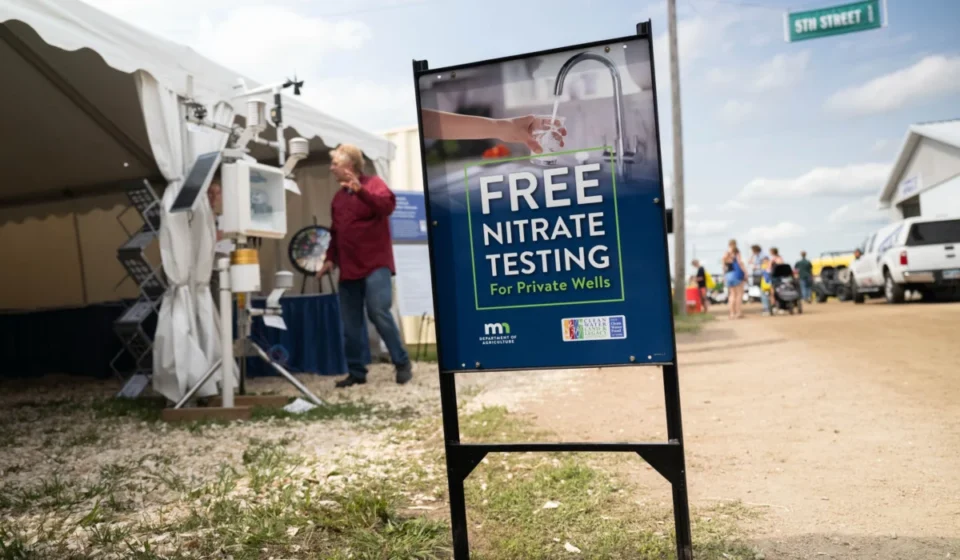
Amidst the familiar sights and sounds of Farmfest—the scent of deep-fried corn dogs, the hum of heavy machinery, and the high-stakes political maneuvering—a small, unassuming booth run by the Minnesota Department of Agriculture (MDA) offers a stark contrast to the festival’s festive atmosphere. On a nondescript table sits a spectrophotometer, a gray, briefcase-sized plastic device that serves as the frontline in a decades-long battle against a colorless, odorless, and potentially dangerous threat: nitrate contamination in private drinking wells.
As attendees pass by, many carrying Ziploc bags filled with water from their home faucets, the reality of Minnesota’s groundwater crisis becomes clear. A sample is poured into a clear tube, an ultraviolet ray flashes through the liquid, and thirty seconds later, a number appears on a digital display. For one attendee, the reading is 7.3 milligrams per liter. It is a number that sits uncomfortably close to the federal safety threshold, serving as a reminder that for thousands of rural Minnesotans, the water coming from their tap is a source of quiet anxiety.
The Invisible Threat: A State-Wide Challenge
Nitrate contamination is not a new phenomenon in Minnesota, but it remains one of the state’s most persistent environmental and public health challenges. The contamination is largely a byproduct of modern agriculture—specifically the nitrogen-rich fertilizers and manure runoff that leach into the groundwater. In regions characterized by porous geology or shallow well infrastructure—particularly in southwest, southeast, and central Minnesota—this chemical infiltration has become a systemic issue.
For those relying on public water systems, the Safe Drinking Water Act provides a rigorous safety net, mandating that municipal providers meet strict federal standards for chemical contaminants. However, for the estimated 93,000 Minnesotans who rely on private wells, that federal protection does not exist. These residents are essentially left to manage their own water safety, often with limited resources and minimal guidance.
The state’s intervention, spearheaded by the MDA, has evolved since the 1990s when the agency first began offering free nitrate testing. Today, these "nitrate clinics" act as a crucial, albeit reactive, bridge between awareness and action.
Chronology of a Crisis: From Fertilizer to Faucet
The relationship between Minnesota’s agricultural prosperity and its water quality is complex. As the seventh-largest farming state in the nation, exporting approximately $9.3 billion in goods annually, agriculture is the bedrock of the state’s economy. Yet, this economic engine carries a heavy environmental footprint.
The 1990s: The Dawn of Awareness
In the 1990s, the realization that rural groundwater was being compromised by agricultural runoff led the MDA to launch its initial testing initiatives. These early programs were designed to educate well owners about the risks of nitrogen leaching, particularly in areas where shallow aquifers made wells susceptible to surface contamination.
The 2000s–2010s: The Rise of Regulatory Tension
As testing data grew, so did the friction between environmental protection and industrial agriculture. Advocacy groups began documenting the link between high nitrate levels and negative health outcomes, including methemoglobinemia—or "blue baby syndrome"—and, more recently, potential links to higher cancer rates and pregnancy complications. Despite these findings, legislative efforts to tighten standards remained stalled.
2026: The Current Landscape
Today, the state’s approach relies heavily on the Clean Water, Land and Legacy Amendment funds, which finance the free testing clinics seen at events like Farmfest. While these clinics provide invaluable data, they also highlight the limitations of the current strategy: they identify the problem, but they lack the regulatory teeth to address the source of the pollution.
The Economics of Filtration and Filtration Failure
For a household discovering that their well water exceeds the federal safety limit of 10 milligrams per liter, the path forward is rarely simple or affordable.
The primary technical solution for nitrate removal is a reverse osmosis (RO) system. These systems, which filter out contaminants through a semi-permeable membrane, are highly effective but carry a steep price tag. Depending on the installation and the system’s complexity, costs can range from $500 to upwards of $5,000. For many rural families, this is an unexpected and prohibitive household expense.

The inequality of the situation is further highlighted by geography. While some counties in southeastern Minnesota have secured funding to provide free or subsidized RO systems to residents with high nitrate levels, these programs are the exception rather than the rule. For those living in counties without such initiatives, the only alternatives are to continue drinking contaminated water, purchase bottled water indefinitely, or invest tens of thousands of dollars to drill a new, deeper well—an option that is financially out of reach for many.
Official Responses and the Burden of Proof
Denton Bruening, a long-time MDA employee and veteran of the water testing clinics, views the issue through a lens of pragmatic experience. A former farmer himself, Bruening is careful not to castigate the agricultural community. He emphasizes that nitrate is ubiquitous, appearing in everyday foods like spinach, and that farmers are often the ones most impacted by their own land-management practices.
"We want to make sure that people feel comfortable coming in and having their sample tested," Bruening explains. "And then we also want to make sure that they’re understanding why they may have high nitrates."
However, the agency’s role remains largely educational. While the MDA promotes the "Nitrogen and Fertilizer Management Plan," which encourages best practices like planting cover crops to absorb excess nitrogen, these measures are voluntary. Without state mandates, the adoption of these expensive, labor-intensive tactics rests entirely on the individual farmer’s willingness to absorb the cost.
The Political "Heavy Lift"
The debate over whether to lower the state’s maximum contaminant level (MCL) for nitrates—from the current 10 mg/L down to 3.5 mg/L—is perhaps the most contentious aspect of the crisis. Proponents argue that the current federal standard is outdated and ignores recent studies linking lower levels of nitrate to adverse health impacts, including increased risks of cancer and birth defects.
Tony Runkle, lead geologist of the University of Minnesota’s geological survey, acknowledges the scientific merit of such a shift but emphasizes the political reality. "That would just be a huge heavy lift," Runkle said. "There’d be a ton of opposition from ag."
This opposition is rooted in the immense political influence of the agricultural industry. At events like Farmfest, the convergence of industry leaders, farmers, and politicians from both sides of the aisle creates a powerful lobby that is understandably wary of regulations that could increase production costs or imply systemic culpability for groundwater degradation.
Implications for the Future
As the climate changes and weather patterns in the Midwest become more volatile, the risk of runoff increases. Intense rain events can flush more fertilizer into the groundwater, further stressing already vulnerable wells.
For the 93,000 Minnesotans relying on private wells, the current "wait and test" system is a tenuous solution. The reliance on individual responsibility—asking a homeowner to pay thousands for a filter to clean water polluted by regional agricultural practices—is increasingly viewed by public health experts as an unsustainable model.
Until the state finds a way to bridge the gap between agricultural policy and public health safety, the scene at the Farmfest booth will continue to repeat itself: a worried homeowner, a gray plastic machine, and a number on a screen that determines the quality of life for a family.
As Bruening notes, many have already given up on their tap water, shifting to a reliance on bottled water as their only sense of security. It is a quiet, individual solution to a massive, collective problem—a testament to the fact that while the water might be clear, the path toward a long-term, equitable solution remains deeply murky.