
























































The New Iron Age: Niron Magnetics and the $1.8 Billion Quest to Transform Minnesota’s Iron Range

ST. PAUL, MN — For decades, the narrative of Minnesota’s Iron Range has been one of industrial decline, defined by the slow erosion of the taconite industry and a bitter, multi-generational tug-of-war between mining interests and environmental conservationists. However, a burgeoning technological breakthrough born at the University of Minnesota is threatening to rewrite that script.
Minneapolis-based Niron Magnetics is currently scouting the Iron Range for its third and largest production facility—a massive $1.8 billion project that promises to create over 700 high-paying jobs and position the United States as a leader in the global "rare-earth-free" magnet market. If realized, the facility would represent one of the most significant industrial investments in Northern Minnesota’s history, offering a rare "third way" that provides massive economic growth without the environmental volatility associated with traditional hard-rock mining.
Main Facts: A Paradigm Shift in Magnet Manufacturing
At the heart of Niron Magnetics’ expansion is a patented technology that utilizes iron and nitrogen—two of the Earth’s most abundant elements—to create "Iron Nitride" magnets. These permanent magnets are essential components in everything from electric vehicle (EV) motors and wind turbines to defense systems and consumer electronics.
The significance of this development cannot be overstated. Currently, the global supply chain for high-performance magnets is dominated by rare-earth minerals like neodymium and dysprosium. China controls approximately 70% of the mining of these minerals and upwards of 90% of the manufacturing of the magnets themselves. By utilizing iron—a resource the Iron Range has in abundance—and atmospheric nitrogen, Niron seeks to decouple the U.S. green energy economy from Chinese supply chains.
The proposed $1.8 billion plant is staggering in scale. Spanning roughly 1.6 million square feet, the facility is slated to begin construction by 2028, with a target production date of 2029. Once fully operational, it is expected to produce 10,000 tons of magnets annually. This would be a massive leap from the company’s pilot operations and its mid-scale plant currently under construction in Sartell, near St. Cloud.
Chronology: From Lab Bench to Industrial Powerhouse
The journey of Niron Magnetics began not in a mine, but in a laboratory at the University of Minnesota.
- The Invention (Early 2010s): Professor Jian-Ping Wang and his team discovered a method to stabilize iron nitride in a way that produced magnetic properties comparable to rare-earth magnets. This breakthrough offered the first viable alternative to the expensive and environmentally taxing rare-earth extraction process.
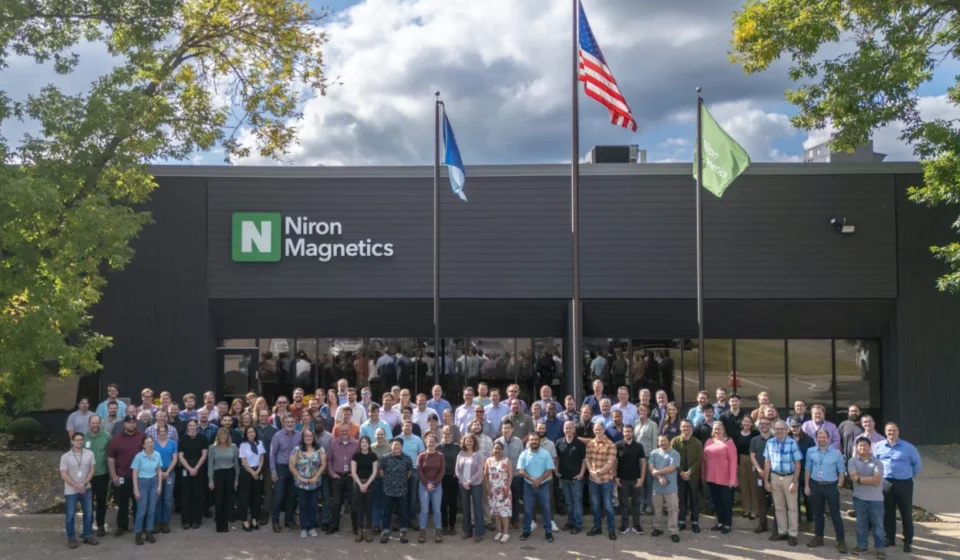
- Commercialization and Pilot Phase: Following the patenting of the technology, Niron Magnetics was formed. The company established its headquarters and a pilot plant in Northeast Minneapolis. This facility, which currently employs 185 people, served as the proving ground for scaling the chemical process.
- Sartell Expansion (2023–Present): In 2023, Niron broke ground on its first commercial-scale production plant in Sartell, Minnesota. Supported by a $10 million investment from the Minnesota Department of Employment and Economic Development (DEED), this facility is expected to employ 175 workers and produce 1,500 tons of magnets annually.
- The Iron Range Site Selection (2024): This spring, Niron hired Savills, a global commercial real estate advisory firm, to begin the site selection process for its "Gigafactory" equivalent. While other states are reportedly being considered, Minnesota’s Iron Range has emerged as a frontrunner due to its existing infrastructure and workforce.
- Future Roadmap (2028–2029): The company aims to begin construction on the $1.8 billion facility in 2028, with a goal of reaching $1 billion in annual revenue shortly thereafter.
Supporting Data: Breaking the Rare-Earth Monopoly
The economic and geopolitical tailwinds driving Niron’s expansion are supported by stark market data. The Center for Strategic and International Studies (CSIS) notes that the U.S. largely abandoned rare-earth mining decades ago due to the extreme environmental degradation caused by the chemical separation process and the lower costs offered by Chinese competitors.
Niron’s strategy addresses three critical data points:
- Supply Chain Risk: China’s recent implementation of export controls on rare-earth processing technologies has created a "crisis of availability" for Western manufacturers.
- Cost Advantage: By using commodity iron ore and nitrogen rather than rare-earth minerals, Niron expects to significantly undercut the price of traditional high-performance magnets.
- Capital Backing: The company has already raised approximately $300 million in public and private capital. Its blue-chip investor list includes GM Ventures, Volvo, Samsung Ventures, Stellantis (the parent company of Chrysler and Fiat), and Western Digital. Additionally, the U.S. Department of Energy has provided grants to accelerate the domestic production of these critical materials.
Official Responses: A Bipartisan Consensus
In a political climate often defined by gridlock, Niron’s potential expansion onto the Iron Range has garnered rare unanimous support from Minnesota’s leadership.
"Minnesota has an opportunity to address this crisis and offer a transformative solution to U.S. commercial and defense manufacturers," Niron said in a recent corporate statement. CEO Jonathan Rowntree echoed this sentiment, emphasizing that the project is about "rebuilding U.S. manufacturing capability for technologies that are essential to the global economy."
State economic development officials are aggressively courting the project. Ryan Malich, executive director of business development at the Minnesota Department of Iron Range Redevelopment and Resources (IRRR), views the plant as the ultimate evolution for the region.
"These are the types of jobs that we’re trying to add to the area in evolving, innovative technologies," Malich said. "We have a highly skilled, available workforce. All the elements seem to line up well for this potential development."
Kevin McKinnon, Deputy Commissioner of DEED, highlighted the "compelling" nature of the Minnesota location. "The promise, the trajectory of where they are going is very exciting," McKinnon said. "The third project would dwarf Sartell. The scale is exciting."
Notably, the project has also received the blessing of U.S. Representative Pete Stauber (R-Duluth), a staunch advocate for traditional mining. This bipartisan alignment is significant, as it suggests that Niron is viewed not as a replacement for mining, but as a high-tech complement to the region’s industrial identity.
Implications: A Strategic Alternative to Mining Conflict
The most profound implication of Niron’s interest in the Iron Range is how it contrasts with the ongoing battle over the Twin Metals project.
For years, the Twin Metals plan to mine copper, nickel, and cobalt near the Boundary Waters Canoe Area (BWCA) watershed has been a flashpoint of controversy. While proponents argue it is necessary for the green energy transition, opponents fear the risk of acid mine drainage into the pristine wilderness.
Niron offers a different path. Because its facility would be a manufacturing plant rather than a hard-metal mine, and because it would likely be located on the site of a shuttered taconite plant outside the BWCA watershed, it avoids much of the environmental "baggage" that has stalled other projects.
Economic Diversification
The Iron Range has suffered for decades as modern domestic mills increasingly use recycled steel feedstock rather than virgin taconite. A $1.8 billion Niron plant would provide a massive "multiplier effect," supporting local contractors, service industries, and logistics providers. It would transform the Range from a source of raw materials into a hub of high-value, finished technological products.
National Security
The defense implications are equally significant. Permanent magnets are foundational to the guidance systems of missiles, the motors of naval vessels, and the avionics of fighter jets. By establishing a domestic source for these components, Minnesota would become a critical node in the U.S. national security infrastructure.
Environmental Stewardship
From a global perspective, Niron’s technology represents a cleaner industrial revolution. Traditional rare-earth mining involves toxic tailing ponds and radioactive byproducts. Niron’s process—reducing iron or recycled steel to powder and mixing it with nitrogen—is inherently more environmentally friendly.
As Niron Magnetics continues its site selection process through the remainder of the year, the stakes for Minnesota’s Iron Range could not be higher. If the state can secure the deal, it would not only revitalize a historic industrial heartland but also provide a global blueprint for how legacy mining regions can reinvent themselves for the 21st century.
The "New Iron Age" may be just around the corner, and it may well be forged in the very same hills that built the American industrial past.