


























































In an era defined by constant connectivity, the modern traveler is increasingly seeking the antithesis of the digital age: profound, luxurious silence. As the hospitality industry evolves, a new category of "high-end off-grid" accommodation has emerged. These properties prove that sustainability and five-star indulgence are not mutually exclusive. From solar-powered jungle retreats in Belize to minimalist, architecturally significant structures in the Moroccan countryside, the "off-grid" movement is no longer just about survival—it is about curated, intentional living.
The Evolution of Sustainable Tourism: Main Facts
The rise of off-grid luxury is driven by a global shift toward eco-consciousness and the psychological need for digital detoxification. These properties typically utilize renewable energy sources, such as solar arrays and hydroelectric power, and are often constructed using locally sourced, sustainable materials.
Unlike traditional hotels, these Airbnbs prioritize environmental integration. Whether it is a "Birdbox" in the fjords of Norway or a converted 1945 boat in the United Kingdom, these stays offer a transformative experience by removing the friction of modern infrastructure while retaining the comforts of a boutique resort. They are destinations unto themselves, designed for travelers who view their accommodation as the primary focal point of their journey rather than a mere base of operations.
Chronology: A Global Tour of Off-Grid Sanctuaries
To understand the breadth of this movement, one must look at the specific regions currently leading the charge in sustainable architectural innovation.
1. Valley Stream, Belize: The Peak of Rainforest Opulence
Nestled within a 200-acre private jungle sanctuary, Valley Stream is a 5,000-square-foot marvel. Featuring soaring native thatch ceilings and rich Belizean hardwood, this solar-powered home bridges the gap between rugged nature and refined living. Guests are treated to an in-house professional chef, a cliffside rock pool, and private trails that wind through the Maya Mountains.
- Capacity: 6 guests | Price: ~$4,571/night
2. Birdbox, Norway: An Artistic Perspective
Located three hours north of Bergen, Birdbox offers a unique glamping experience that redefines the concept of a room with a view. Guests describe the experience as living inside a rotating landscape painting, with unobstructed views of the Blegja mountain range and the Førdefjord. It is an exercise in minimalism that forces the occupant to engage entirely with the dramatic Nordic environment.
- Capacity: 2 guests | Price: ~$360/night
3. Caipira Modernista, Brazil: Architectural Mastery
As Brazil’s first 100-percent off-grid sustainable home, Caipira Modernista in Catuçaba stands as a testament to conscious architecture. Built in a neutral, earthy palette, the home derives its power from the sun and its water from mountain springs. It is a space designed for contemplation, with an extensive terrace offering panoramic sunset views.
- Capacity: 8 guests | Price: ~$802/night
4. The Boat Shack, United Kingdom: Historic Minimalism
Tucked away in a private forest just outside of Ely and Cambridge, this 1945 boat—the Anthony Stevenson—has been meticulously converted into a sustainable glamping vessel. It represents a "micro-luxury" approach, where the charm of history meets the modern necessity of renewable solar energy.
- Capacity: 2 guests | Price: ~$219/night
5. Casa Bell, Costa Rica: The Rainforest Oasis
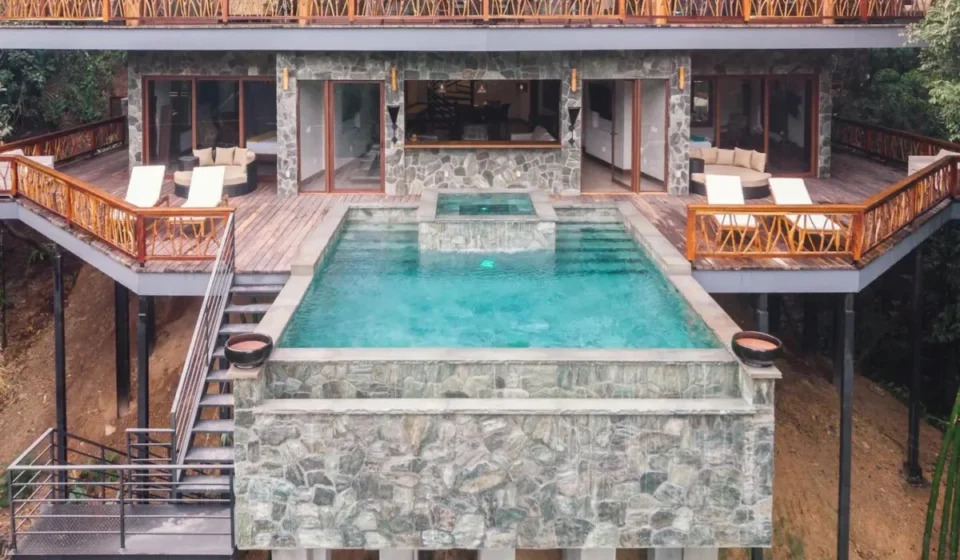
Perched near Montezuma, Casa Bell serves as a prime example of eco-integration. With an outdoor shower, fire pit, and private pool, the home offers a seamless transition between the luxury of a modern villa and the raw vitality of the Costa Rican rainforest.
- Capacity: 7 guests | Price: ~$284/night
6. NeoNauta 23, Spain: The Digital Nomad’s Sanctuary
Constructed in 2021, this property on the Canary Islands proves that even the most remote, volcanic landscapes can be modernized for the remote worker. With high-speed fiber-optic connectivity, dedicated office space, and direct pool access, it provides a solution for those who wish to work while surrounded by the untamed beauty of Spain’s volcanic terrain.
- Capacity: 6 guests | Price: ~$305/night
7. Hogan by the River, Arizona: Navajo Nation Tradition
This traditional earth home (hogan) offers a raw, unplugged experience. By eschewing electricity and plumbing, the property honors the spirit of the Navajo Nation. It is a destination for the purist, situated near the Grand Canyon and Monument Valley, offering arguably the best stargazing opportunities in North America.
- Capacity: 2 guests | Price: ~$166/night
8. The "Loop," Morocco: The Hedonist’s Escape
Located in the Marrakech countryside, this clay-built structure is an architectural landmark. It accommodates up to 12 guests and combines the rugged beauty of the Atlas Mountains with the high-touch service of a personal chef, demonstrating that off-grid living can be scaled for large gatherings.
- Capacity: 12 guests | Price: ~$579/night
Supporting Data: Why Travelers are Choosing Off-Grid
Market analysis suggests that demand for "secluded" and "eco-friendly" stays has increased by over 40% since 2020. Data from travel platforms indicates that guests are willing to pay a premium—not just for luxury amenities, but for "privacy" and "uninterrupted nature."
The shift is further supported by the "work-from-anywhere" trend. Properties like NeoNauta 23 demonstrate that the industry is successfully equipping remote locations with the technological infrastructure—such as Starlink or high-speed wireless—required to maintain productivity while disconnected from the standard power grid.
Official Responses and Industry Trends
Hospitality experts note that the "off-grid" label is becoming a major selling point for high-net-worth individuals. "Sustainability is no longer a niche preference; it is a baseline expectation for the modern luxury traveler," says one industry consultant. "We are seeing a move away from the ‘gold-plated’ luxury of the 20th century toward ‘experience-based’ luxury, where the primary amenity is the scarcity of human contact."
Governments and local tourism boards are also responding. In regions like Costa Rica and the Canary Islands, incentives are being offered to developers who utilize renewable energy and low-impact construction techniques. These policies are designed to protect the very environments that attract tourists in the first place.
Implications: The Future of Responsible Travel
The proliferation of these off-grid Airbnbs carries significant implications for the future of the travel sector:
- Preservation through Profit: By making off-grid living profitable, developers are providing an economic incentive to preserve forests, mountains, and coastal regions rather than developing them into high-density resorts.
- Technological Integration: The success of these homes is largely due to advancements in battery storage and solar efficiency, which have made "living off the grid" feel significantly less like "roughing it."
- Psychological Impact: As burnout rates continue to rise, the ability to disappear into a "Birdbox" in Norway or a jungle villa in Belize provides a necessary reprieve. The "off-grid" experience is becoming a form of preventative healthcare, allowing travelers to reset their nervous systems away from the blue light and noise of the city.
In conclusion, the movement toward off-grid luxury is not merely a trend—it is a recalibration of what it means to be a traveler. It suggests that the ultimate luxury in the 21st century is not found in a grand hotel lobby, but in the silence of a mountain breeze, the warmth of a solar-powered home, and the freedom of being entirely, comfortably, alone.