






















































Beyond the Blacktop: How Cities are Rethinking the Urban Parking Lot to Combat Climate Change

For decades, the standard American landscape has been defined by vast, heat-trapping seas of asphalt. From suburban malls to downtown office centers, the "blacktop" has served as the default solution for vehicle storage. However, as extreme heatwaves intensify and urban flooding becomes a more frequent, destructive reality, city planners and environmental advocates are beginning to view these ubiquitous grey spaces not as neutral infrastructure, but as significant contributors to the climate crisis.
Across the United States, a quiet revolution is taking place in parking lots. From Virginia to California, institutions and municipalities are ditching traditional pavement in favor of innovative, permeable, and cooling alternatives designed to restore the urban environment’s ability to "breathe."
The Climate Cost of Impervious Surfaces: Main Facts
The primary issue with conventional asphalt is its inherent nature: it is impervious. When rain falls on a standard parking lot, it has nowhere to go but into storm drains, often carrying oil, heavy metals, and road debris directly into local waterways. Furthermore, asphalt is a notorious heat sink. Its dark color absorbs solar radiation throughout the day, storing thermal energy and releasing it at night. This phenomenon, known as the "urban heat island effect," can cause local temperatures to spike as much as 20 degrees Fahrenheit higher than in surrounding green spaces.
The Hampton Roads Planning District Commission in Virginia recently addressed this at their own headquarters. Faced with a crumbling parking lot, they opted for an overhaul rather than a simple repaving. The new facility, completed last year, utilizes porous concrete panels and integrated native landscaping.
"The rain infiltrates faster than it can puddle and stop on the surface," explains Jill Sunderland, the commission’s senior water resources planner. Beyond the hydrological benefits, the change in material has had a tangible impact on the microclimate. "You notice, too, that it’s cooler," Sunderland says. "You really can tell a difference out there—not to mention it’s just more inviting."
A Timeline of Transformation: From Pavement to Permeability
The movement to transform parking infrastructure has gained momentum over the last decade, driven by shifting public policy and a greater understanding of environmental sustainability.
- Early 2010s: Municipalities begin experimenting with "green infrastructure" as a way to meet federal mandates for stormwater management. Cities like Philadelphia and Seattle introduce "Green Factor" requirements, forcing developers to account for the environmental impact of their land use.
- 2016: The discourse moves toward urban planning, with cities like Minneapolis and Buffalo beginning to question "minimum parking requirements." By removing these mandates, cities allow developers to build less parking, thereby reducing the amount of land paved over.
- 2020: The City of New Orleans officially formalizes its commitment to climate resilience, requiring the Department of Public Works to utilize permeable paving in all municipal projects where practical.
- 2022–2024: The "dePaving" movement gains traction in cities like Denver, where initiatives focus on actively removing unnecessary asphalt and replacing it with green space.
- 2025–Present: High-profile pilot programs, such as those at the Newfields art museum in Indianapolis, demonstrate that alternative materials—like recycled plastic grid pavers—can successfully handle overflow parking without the environmental cost of solid blacktop.
Supporting Data: Why Change is Necessary
The scale of the problem is vast. According to Adam Millard-Ball, a professor of urban planning at UCLA, parking occupies a staggering 25% or more of the land in many American downtowns. Crucially, studies indicate that more than a third of these spaces sit empty at any given time.

The economic and environmental logic for change is becoming impossible to ignore:
- Energy Consumption: Warmer neighborhoods lead to increased reliance on air conditioning. AC units, in turn, exhaust heat back into the environment, creating a feedback loop that further elevates ambient temperatures.
- Water Management: Bioswales and rain gardens—landscaped depressions that capture runoff—can filter out significant percentages of pollutants before they reach municipal sewers, reducing the financial burden on city water treatment facilities.
- Material Longevity: While alternative materials may have a higher upfront cost, their "lifetime value" often exceeds that of asphalt, which requires frequent sealing and patching as it ages and cracks.
Innovative Solutions: A Toolkit for Cooling
As cities look for ways to mitigate the heat, they are deploying a variety of technologies:
Cooling Technologies and Shading
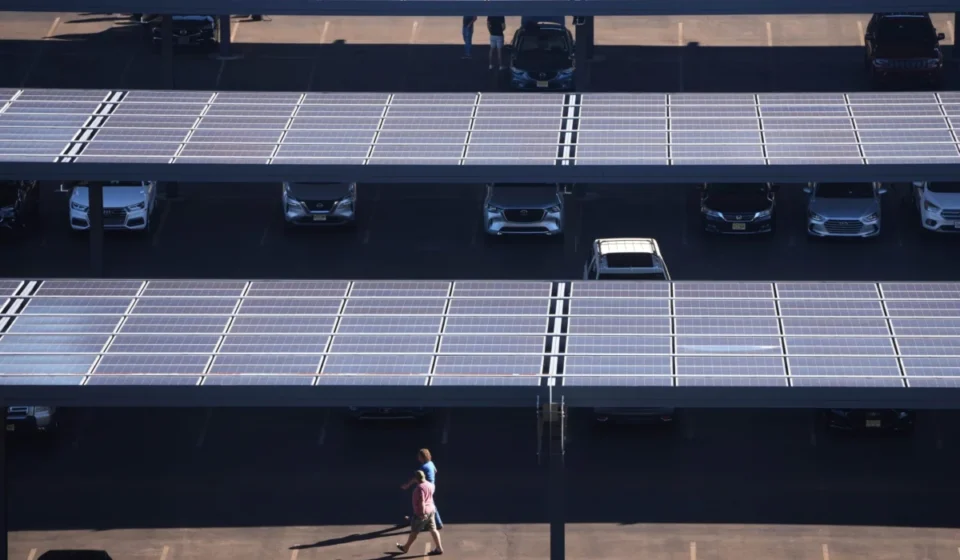
Reflective coatings, similar to high-durability paint, are being tested in neighborhoods like Pacoima in Los Angeles. These "cool pavements" reflect more sunlight, preventing the ground from absorbing thermal energy. In cities like Sacramento, local ordinances now require developers to plant enough trees to shade at least 50% of a parking lot within 15 years of construction. Furthermore, solar canopies—structures that provide shade while generating clean electricity—are emerging as a dual-purpose solution that turns an empty space into a power plant.
Stormwater Runoff Solutions
For those areas that must remain paved, permeability is key. Lattice pavers and interlocking concrete systems create gaps that allow water to filter into the soil. Some designs even allow grass to grow through the pavers, further cooling the area through evapotranspiration. At Newfields in Indianapolis, the use of recycled plastic grids allows the overflow lot to "breathe" when it isn’t being used, a stark contrast to the stifling nature of a traditional lot.
Official Responses and Industry Perspectives
Not all stakeholders are sold on the immediate abandonment of traditional materials. The asphalt industry, led by groups like the Asphalt Pavement Alliance, argues that asphalt remains the most versatile and durable solution for high-traffic areas.
"I just think we need to be really, really careful when we put alternative systems in to make sure that we have a good understanding of what the life cycle impact is going to be," says Buzz Powell, technical director at the Alliance. He warns that while permeable materials look excellent on paper, they may fail under the weight of heavy vehicles like trash trucks or emergency equipment.
Powell advocates for the modernization of asphalt rather than its replacement. "My focus is 100% to make asphalt better," he explains. "If we do better asphalt, that means better mixing materials, better structural pavement design, and better pavement preservation."

Meanwhile, urban planners and environmentalists like Vincent Cotrone, an urban forestry educator at Penn State, acknowledge the budgetary constraints that prevent many cities from retrofitting existing lots. "We are headed in the right direction," Cotrone notes, "but at the same time, we’ve got acres and acres of nothing but blacktop parking lots that sit there and age and heat up. And we just don’t have the dollars to go retrofit those."
Implications for the Future
The path forward is not necessarily to ban asphalt, but to optimize how we use land. The push to drop minimum parking requirements is a critical step in this transition. By allowing market demand—rather than outdated zoning laws—to dictate the amount of parking, cities can naturally reduce the footprint of heat-trapping surfaces.
The shift is as much about social equity as it is about environmental health. Urban heat islands disproportionately affect lower-income neighborhoods, which often lack the tree canopy and green infrastructure of wealthier areas. Replacing a barren, cracked parking lot with a permeable, shaded, and landscaped space can improve the quality of life, lower utility bills, and reduce flood risk for residents in these communities.
As Greg Kats, founder of the Smart Surfaces Coalition, observes, the impact of a single project may seem small, but the cumulative effect of a city-wide strategy is profound. "The reality is, one city changing their surfaces is just not by itself going to have a big impact," Kats says. "But once cities are able to understand in a rigorous way the scale of the benefits—it’s kind of intuitive."
Ultimately, the transformation of the American parking lot represents a shift in philosophy: moving away from a "set it and forget it" approach to infrastructure toward a more dynamic, sustainable, and climate-resilient future. Whether through better-engineered asphalt or the adoption of green, permeable alternatives, the goal remains the same: creating urban spaces that serve the needs of people without compromising the health of the planet.