





















































The Iron Range’s High-Tech Renaissance: Niron Magnetics and the $1.8 Billion Quest to End Rare-Earth Dependency

For over a century, the jagged skyline of Minnesota’s Iron Range has served as a monument to American industrial might. But as the taconite industry weathered decades of decline—squeezed by global competition and the rise of recycled steel—the region has long searched for a "second act." While national headlines have focused on the fierce environmental battles over copper-nickel mining near the pristine Boundary Waters Canoe Area (BWCA), a different, potentially more transformative opportunity is quietly taking shape.
Minneapolis-based Niron Magnetics is currently scouting the Iron Range for its third and largest production facility: a massive $1.8 billion plant that could redefine the region’s economic identity. By leveraging a breakthrough technology developed at the University of Minnesota, Niron aims to replace the world’s reliance on "rare-earth" minerals—currently a market dominated by China—with magnets made from two of the most abundant elements on Earth: iron and nitrogen.
Main Facts: A Paradigm Shift in Magnet Manufacturing
Niron Magnetics’ proposal represents more than just a new factory; it is a strategic move to secure the U.S. supply chain for clean energy and national defense. At the heart of the project is the "Clean Earth Magnet," the world’s first high-performance, rare-earth-free permanent magnet.
Currently, the magnets that power everything from electric vehicle (EV) motors and wind turbines to missile guidance systems and consumer electronics depend on rare-earth elements like neodymium and dysprosium. China controls approximately 70% of the global mining of these minerals and 90% of the refined manufacturing process. Niron’s technology bypasses this bottleneck entirely by using iron and nitrogen.
The proposed "Mega-Plant" on the Iron Range is a project of staggering scale:
- Investment: An estimated $1.8 billion capital expenditure.
- Employment: More than 700 high-paying, skilled manufacturing jobs.
- Production Capacity: 10,000 tons of magnets annually by 2029.
- Footprint: A 1.6 million-square-foot facility, potentially revitalizing a shuttered taconite site.
This development follows the company’s rapid scaling efforts, which include a pilot plant in Northeast Minneapolis and a mid-scale production facility currently under construction in Sartell, Minnesota.
Chronology: From Academic Breakthrough to Industrial Scale
The journey of Niron Magnetics began in the laboratories of the University of Minnesota, where Professor Jian-Ping Wang discovered a way to stabilize iron nitride—a material known for its magnetic potential but long considered too unstable for commercial use.
2014–2021: The Research and Development Phase
Following the initial discovery, Niron worked to refine the "secret sauce" of their patented process. This involves reducing iron or recycled steel into a specialized powder and then introducing nitrogen in a chemical compound. Unlike traditional magnet manufacturing, which requires extreme heat and environmentally hazardous chemical separation, Niron’s process is more energy-efficient and utilizes domestically sourced raw materials.
2022–2023: Pilot Success and Scaling
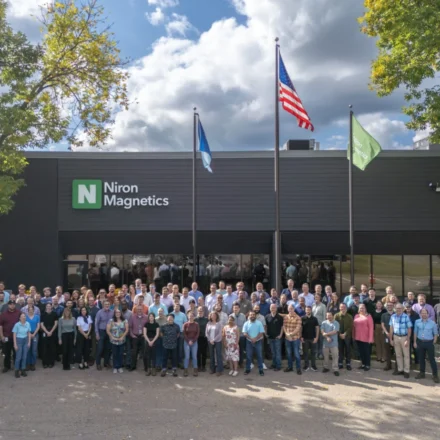
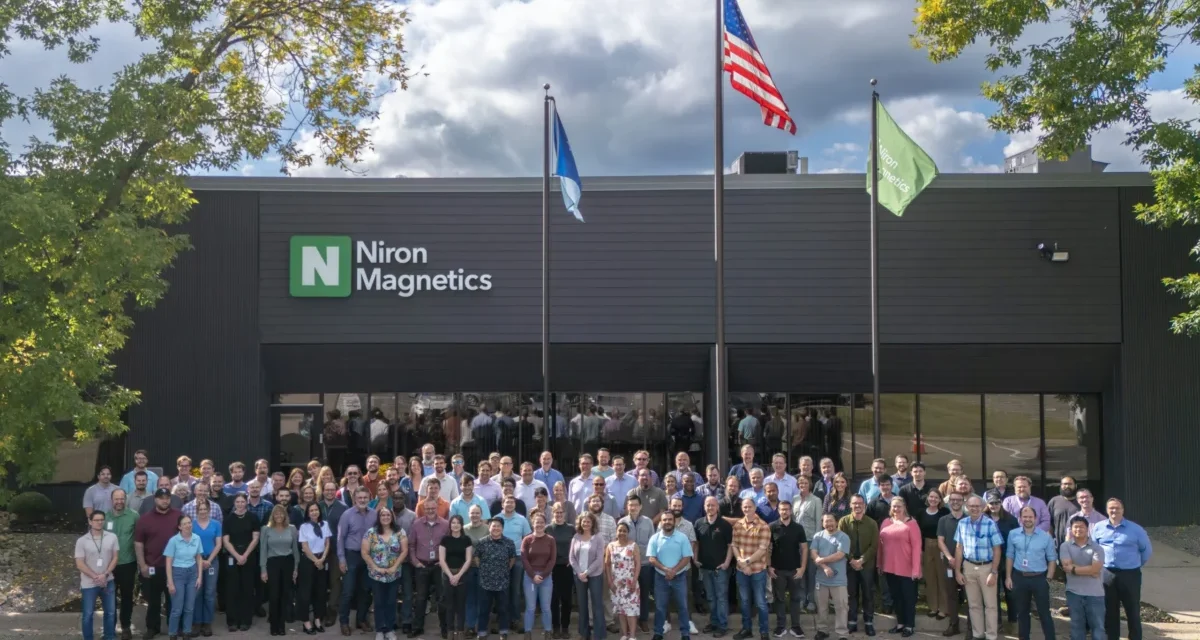
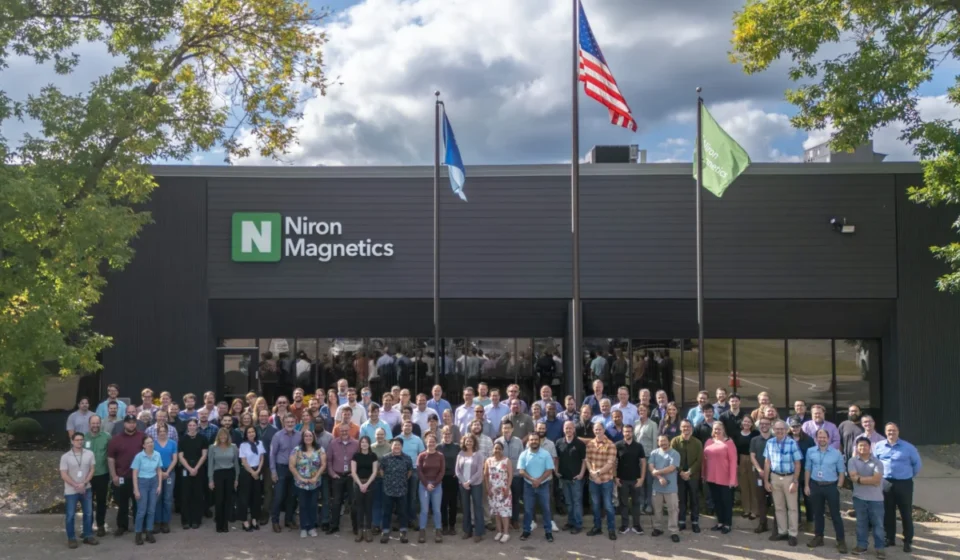
The company established a pilot plant and headquarters in Northeast Minneapolis, currently employing 185 people. This facility served as the proof-of-concept for the industrial-scale application of iron-nitride magnets. In late 2023, Niron broke ground on its first commercial-scale plant in Sartell, near St. Cloud. This $10 million project, supported by state investment, is expected to employ 175 people and produce 1,500 tons of magnets annually.
2024: The Search for the Mega-Site
Earlier this year, Niron CEO Jonathan Rowntree announced the company had hired Savills, a global commercial real estate adviser, to lead the site selection process for its $1.8 billion facility. While other states are being considered, the Iron Range has emerged as a frontrunner due to its existing infrastructure and specialized workforce.
2028–2029: The Future Vision
If the Iron Range is selected, construction is slated to begin in 2028, with full-scale production hitting the market by 2029.
Supporting Data: The Economic and Geopolitical Landscape
The urgency behind Niron’s expansion is driven by a volatile global market. The Center for Strategic and International Studies (CSIS) notes that the U.S. largely abandoned rare-earth mining decades ago due to the immense environmental costs and the difficulty of competing with subsidized Chinese production.
The Chinese Monopoly
China’s recent imposition of export controls on certain rare-earth technologies has acted as a catalyst for Western investment. "The Chinese put export controls in place around rare earths, and that’s been a great benefit to us," Rowntree told Fast Company last fall. "We seek to solve this problem for Western companies as quickly as possible."
Market Demand and Capital
Niron’s rapid ascent is backed by a diverse coalition of public and private investors. The company has raised approximately $300 million to date, with partners including:
- Automotive Giants: GM Ventures, Volvo, and Stellantis (Chrysler/Fiat).
- Tech Leaders: Samsung Ventures and Western Digital.
- Public Sector: The U.S. Department of Energy.
The company anticipates reaching $1 billion in revenue within the next few years, with a potential public offering (IPO) on the horizon to fund the massive capital requirements of the Iron Range facility.
Iron Range Demographics
The Iron Range offers a unique value proposition: a "ready-made" workforce. Decades of taconite mining have produced a labor pool skilled in heavy machinery, metallurgy, and industrial logistics. With taconite production declining as modern mills shift toward recycled steel feedstock, hundreds of workers are seeking a transition into the "green" economy.
Official Responses: Political and Economic Alignment
The prospect of the Niron plant has generated a rare moment of bipartisan enthusiasm in a state often divided by mining policy.
State Development Agencies
Ryan Malich, executive director of business development at the Minnesota Department of Iron Range Redevelopment and Resources (IRRR), views the project as a perfect fit. "These are the types of jobs that we’re trying to add to the area in evolving, innovative technologies," Malich said. "We want to be on the frontside of technological development. We have a highly skilled, available workforce. All the elements seem to line up well."
Kevin McKinnon, Deputy Commissioner of the Department of Employment and Economic Development (DEED), emphasized the state’s commitment. "The promise, the trajectory of where they are going is very exciting," McKinnon said, noting that the third project would "dwarf" the Sartell investment.
Political Leadership
The administration of Governor Tim Walz has been vocal in its support, viewing Niron as a "cleaner" alternative to traditional hard-metal mining. Simultaneously, U.S. Representative Pete Stauber (R-Duluth), a staunch advocate for the mining industry, has also thrown his support behind Niron’s expansion, highlighting the company’s importance to national security.
Implications: A Sustainable Future for Northern Minnesota
The potential arrival of Niron Magnetics on the Iron Range carries profound implications for the region’s environmental and economic debates.
A Contrast to Twin Metals
For years, the Iron Range has been the site of a "permitting battle" regarding the Twin Metals project—a plan by Chilean-owned Antofagasta to mine copper, nickel, and cobalt near the BWCA. While Twin Metals promises jobs, environmentalists fear it would pollute the watershed.
Niron offers a different narrative. Because it utilizes iron and nitrogen rather than the heavy chemical processing required for rare earths or the sulfide-ore mining associated with copper, it is viewed as a significantly lower environmental risk. Furthermore, the plant would be located outside the sensitive BWCA watershed, likely utilizing existing industrial brownfields.
National Security and Supply Chain Resilience
Beyond the local economy, the Niron plant is a piece of a larger puzzle in U.S. industrial policy. By producing magnets from domestic iron and atmospheric nitrogen, the U.S. can insulate its EV and defense industries from geopolitical blackmail. "Permanent magnets are foundational to everything from electric motors to defense," CEO Jonathan Rowntree noted. "Expanding domestic production… will be critical to strengthening supply chain resilience."
Conclusion
As Niron Magnetics and its advisers evaluate sites across Minnesota and beyond, the Iron Range stands at a crossroads. The transition from a region defined by the extraction of raw ore to one defined by the manufacturing of high-tech components could secure its economic future for the next century. If the $1.8 billion "Mega-Plant" breaks ground in 2028, it will not just be a victory for Niron, but a signal that the American Heartland is capable of leading the global transition to a sustainable, independent industrial future.