

























































In the rapidly evolving landscape of enterprise IT, a silent revolution is underway. As artificial intelligence moves from a passive assistant to an active participant in infrastructure management, the traditional role of the IT administrator is undergoing a profound metamorphosis. The core challenge facing modern organizations is no longer just managing devices; it is managing the autonomous agents tasked with controlling those devices.
Enter Smplify, a nascent player in the device management market that has recently secured $1 million in pre-seed funding. Led by industry veterans Ben Greiner and Preetham Gurram—the latter a key figure in the development of Apple’s zero-touch enrollment and core MDM platforms—Smplify is positioning itself as the "last-mile control plane" for an era defined by machine-speed administration.
The Paradigm Shift: From Human-Led to Machine-Speed
For decades, device management has been a human-centric endeavor. Admins would craft scripts, monitor pipelines, and manually intervene when fleet health drifted from the desired state. However, the integration of AI agents has introduced a dangerous capability: the power to act on a fleet at speeds no human can oversee.
"Device management still assumes a person is watching," says Ben Greiner, co-founder and COO of Smplify. "Admins already automate with scripts, and now AI agents are showing up that can act on a fleet at machine speed. The challenge for IT is that AI is beginning to take actions, rather than suggest them. That means IT must put systems in place to audit the actions those agents take."
The current market reality is stark. According to a recent report by OneTrust on AI-ready governance, while 87% of organizations are actively encouraging the use of AI agents, fewer than half—only 47%—have implemented the necessary governance and controls to manage them. This discrepancy represents a ticking time bomb for enterprise security and operational stability.
Chronology: The Evolution of Managed Infrastructure
To understand the necessity of Smplify’s approach, one must look at the timeline of device management evolution:
- The Manual Era (Pre-2010s): IT departments relied heavily on manual intervention, image deployment, and localized script execution.
- The MDM Era (2010–2020): Mobile Device Management platforms standardized fleet oversight, allowing for remote configuration and security policy enforcement.
- The Declarative Era (2020–2023): Apple introduced Declarative Device Management (DDM), shifting the model from constant "polling" to a state-based system where devices report their own status against a defined "intent."
- The Agentic Era (2024–Present): The introduction of AI agents capable of writing and executing their own configuration scripts. This creates a "black box" problem where intent is no longer fully transparent to the human administrator.
The industry is currently transitioning into this "Agentic Era," where the potential for catastrophic, fleet-wide failure—such as an agent misinterpreting a command and wiping thousands of devices—has shifted from a theoretical risk to an operational reality.
Supporting Data: The Cost of Unmanaged Intelligence
The risks associated with unchecked AI are not merely technical; they are financial and existential. Gartner recently projected that by 2027, as many as 40% of enterprises will be forced to demote or decommission autonomous AI agents. The primary driver for this retreat is the discovery of governance gaps only after significant, costly security or operational incidents have occurred.
The complexity of the problem is compounded by the "recovery debt." Fleet CEO Mike McNeil highlights that risk is a function of two variables: the privilege level of the code and the difficulty of recovery.
"I’d frame risk by two things: how much privilege the code runs with and how hard recovery is," McNeil noted. When AI agents operate at the root level—which is often necessary for effective device management—a single hallucinated or erroneous command can lead to a state where standard reversion tools are rendered useless. The cost of manual recovery for a fleet of thousands of devices can reach millions of dollars in downtime and labor, making "damage limitation" an insufficient strategy.
Official Responses and Industry Approaches
The gravity of the situation has not gone unnoticed by the major players in the MDM space. Industry giants like Jamf are pivoting their product roadmaps to prioritize AI governance.
Jamf CEO Beth Tschida has been vocal about the inevitability of this trend. "AI is happening whether organizations know it or not," Tschida stated earlier this year. "It’s far better to build visibility and governance around it." In July, Jamf launched an AI Governance suite specifically designed to address tool discovery, policy enforcement, and reporting—a clear signal that the market is beginning to prioritize guardrails over raw, unbridled automation.
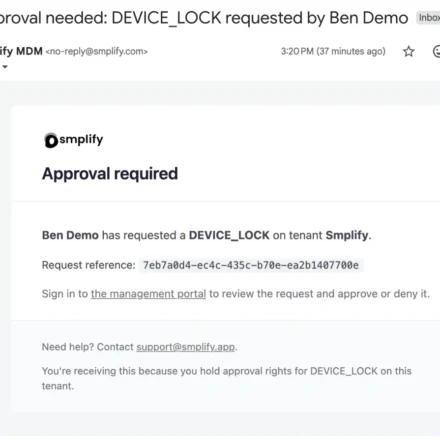
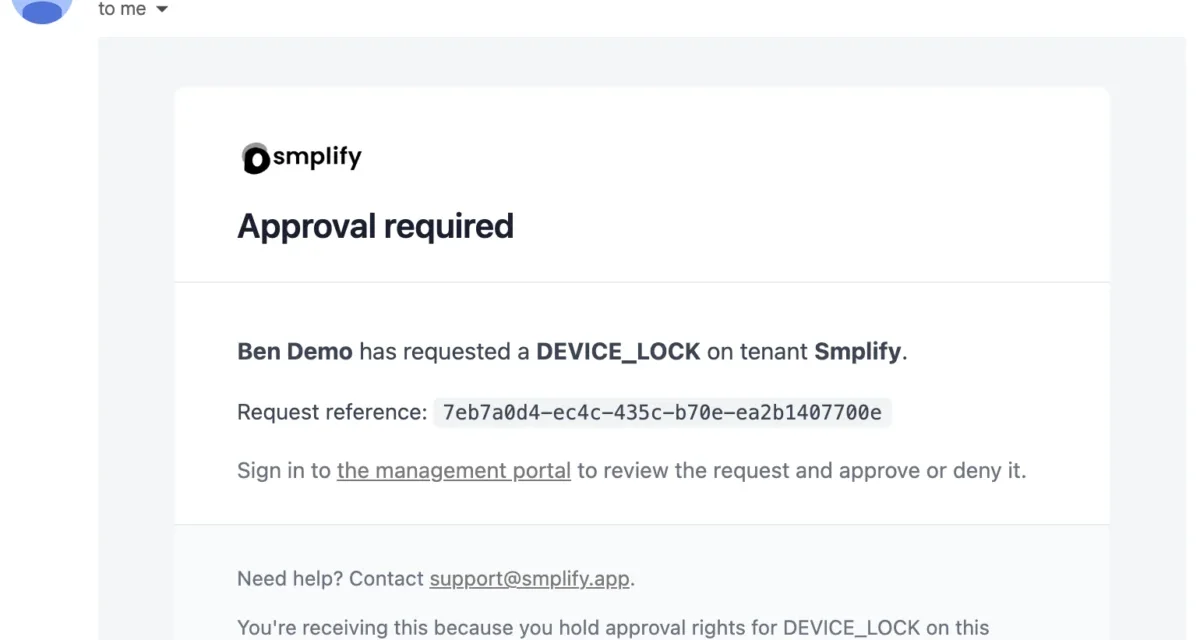
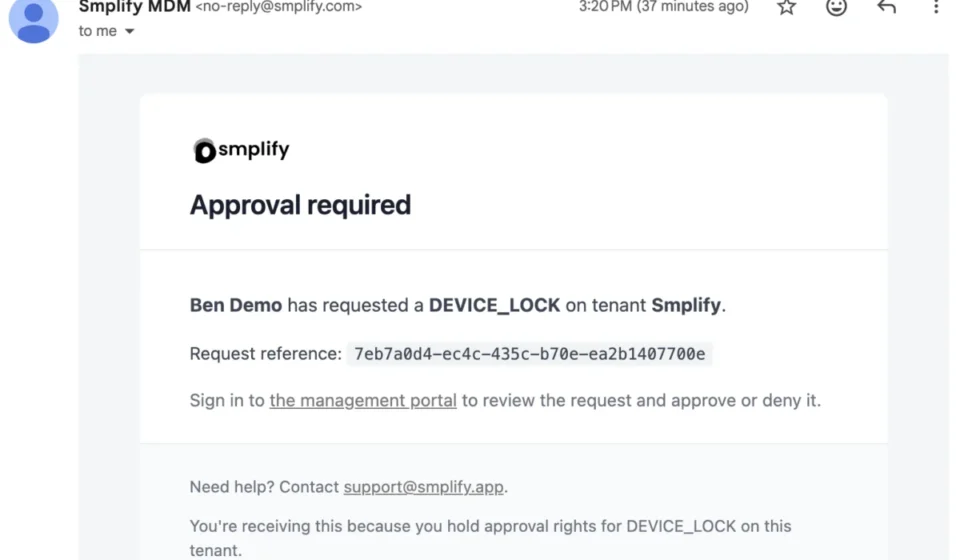
Smplify’s approach, however, takes a more granular path. By acting as a headless, API-first platform, Smplify integrates directly into the existing workflows of DevOps and IT teams. By implementing what the founders call a "last-mile control plane," Smplify ensures that every action taken by an AI agent is subjected to a final checkpoint. The agent may "decide" on a solution, but the platform prevents the execution of that solution until it has been vetted, logged, and authorized against a set of predefined policies.
The Future: Governance as a Strategic Advantage
The "winning" enterprises of the future will not necessarily be those with the most advanced AI models, but those with the most robust governance frameworks. As Greiner puts it, "The enterprises that win won’t be the ones with the smartest agents; they’ll be the ones that can say exactly what each agent is allowed to do and prove what it did."
The Role of Declarative Boundaries
The integration of Apple’s DDM protocols into these new management platforms is essential. By defining a "desired state" for devices, IT teams can create a boundary within which AI agents are permitted to operate. If an agent attempts to push a configuration that deviates from the established intent, the platform can automatically block the change or trigger a human review.
This mimics the "GitOps" discipline that has successfully brought stability to software engineering for years. By treating device configurations like code—versioned, peer-reviewed, and logged—IT teams can achieve the same level of discipline in fleet management.
Privacy and the Apple Intelligence Factor
The conversation is further complicated by Apple’s own integration of AI. As Apple introduces Apple Intelligence features across its ecosystem, the role of the IT admin is to act as the arbiter of what data stays on-device and what is processed in the cloud. Apple’s inherent focus on privacy and on-device processing provides a natural foundation for these new governance tools, allowing companies to leverage AI capabilities while maintaining strict compliance with privacy standards.
Implications for the IT Professional
For the IT professional, the rise of managed AI represents a transition from "operator" to "architect." The manual, repetitive tasks of yesterday are being offloaded to autonomous agents. In their place, a new set of responsibilities emerges:
- Policy Definition: Clearly articulating the "rules of engagement" for AI agents.
- Auditability: Maintaining a transparent ledger of every decision an agent has made.
- Architectural Oversight: Designing systems where human-in-the-loop checkpoints are baked into the infrastructure rather than bolted on as an afterthought.
The Smplify mission is to provide the infrastructure for this new architecture. By offering a platform that is entirely API and CLI-driven, they are catering to a new generation of IT professionals who demand the same programmability in their device management tools as they have in their cloud and application infrastructure.
Conclusion: Watching the Watchmen
As we look toward the 2027 Gartner milestone, the message for the industry is clear: the "Wild West" phase of AI in IT management must come to an end. The risk of unmanaged AI is too great to ignore, and the cost of remediation is too high to accept as a routine expense.
The future belongs to the "governed agent." Whether through the comprehensive suites offered by established leaders like Jamf or the lightweight, API-first controls pioneered by startups like Smplify, the focus must shift to accountability. If the machines are to manage our devices, we must ensure they report to a system that understands intent, enforces policy, and—most importantly—retains the power to say "no."
In this new ecosystem, the most valuable tool in the IT arsenal will not be the one that acts the fastest, but the one that ensures that every action taken is deliberate, documented, and aligned with the enterprise’s ultimate goals. The "last-mile control plane" is not just a feature; it is the essential safety net for the autonomous enterprise.